Book a Consultation
HomeSolutionsMachine Data Architecture Blueprint
Solution blueprint

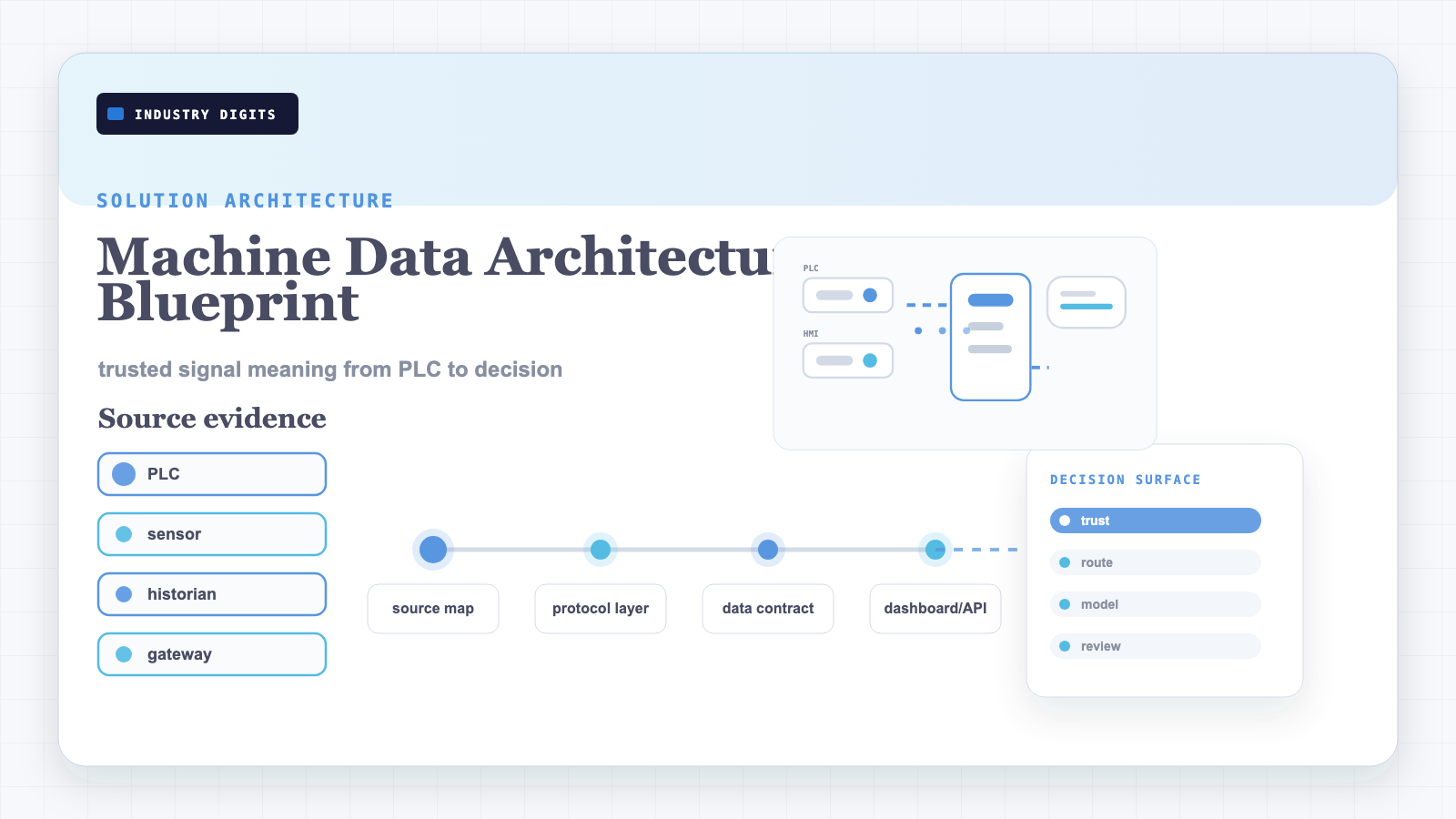
Machine Data Architecture Blueprint

A practical blueprint for preserving machine signal meaning from PLCs, sensors, historians, and edge gateways into trusted dashboards, APIs, and review workflows.

Operating problem

Machine data is often available but not trusted. PLC tags, sensor values, historian exports, and dashboard fields lose meaning when naming, units, timestamp source, state context, and ownership are not designed together.

How to read this blueprint The architecture examples here are reference patterns for designing your own machine-data path. Treat them as a starting topology to adapt — naming conventions, context fields, and ownership boundaries should map to your plant's systems, not be copied verbatim.
Machine Data Architecture Blueprint video poster
00:36 visual explainer brief: Explain how trusted plant data depends on source mapping, protocol choices, data contracts, and decision surfaces.
Symptoms and decision signals

What usually tells the team the problem is real

Dashboard mistrust

People can see the trend, but no one agrees whether the tag, timestamp, or unit is trustworthy.
Protocol confusion

OPC UA, MQTT, historian export, API, or vendor gateway options are discussed before the source and owner are clear.

Weak naming

Tags do not carry machine, unit, state, quality, or operating context needed for long-term use.

AI before readiness

Teams discuss models while the data contract and human review gate are still undefined.
Why common approaches fail

Useful technology fails when the operating decision is undefined

Platform-first buying A dashboard or cloud platform is selected before source mapping, ownership, and acceptance criteria are understood.
Uncontrolled cloud paths Machine data leaves OT without a clear read-only path, security zone, recovery plan, or data owner.
No data contract Signals move, but units, quality flags, timestamps, sample expectations, and state meaning are undocumented.
Too many tags too early Teams collect everything before proving one useful decision path end to end.
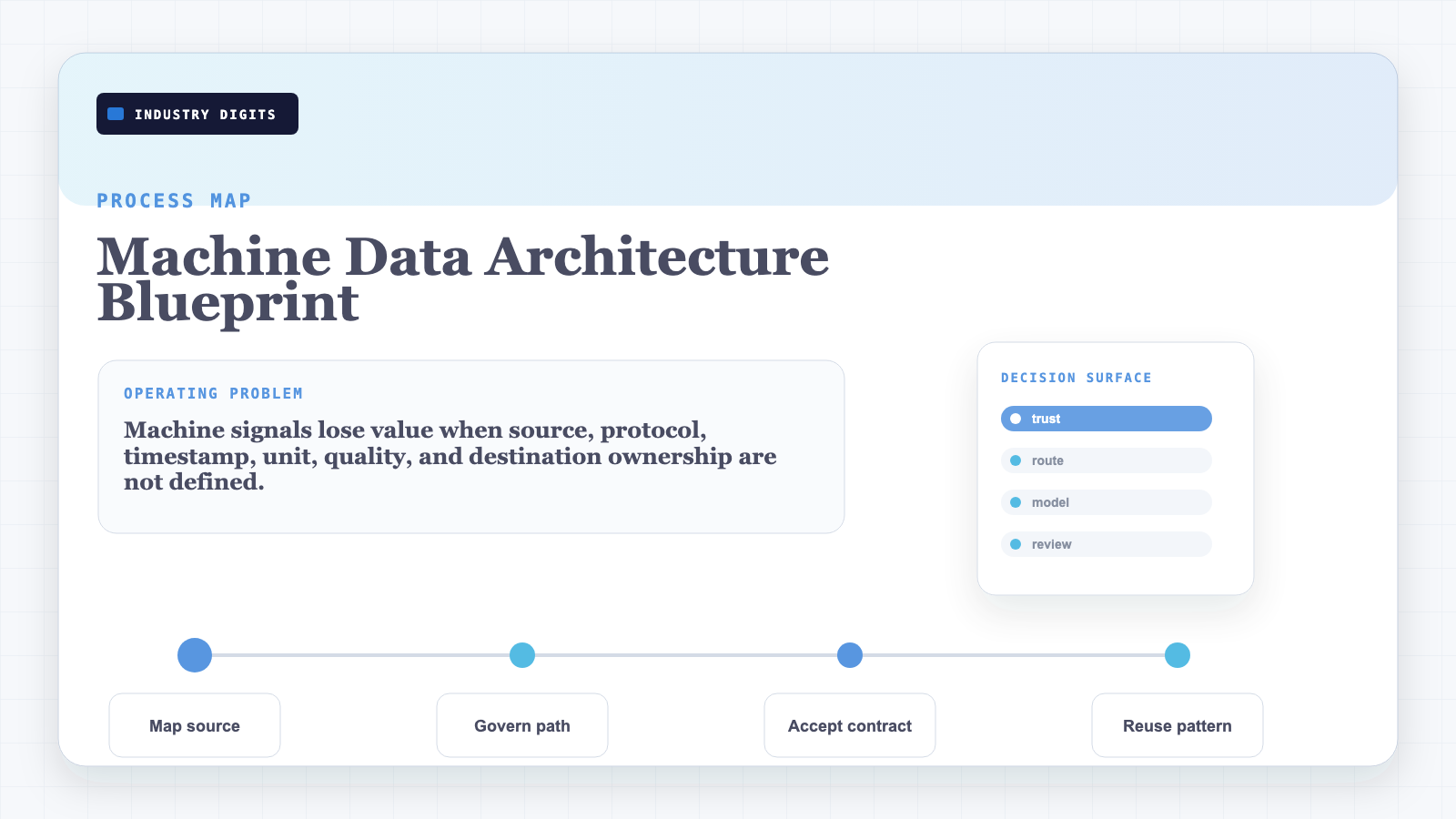
Machine data contract process map from source mapping to acceptance and reusable architecture pattern
Process map: how the issue moves from signal evidence to review and action.
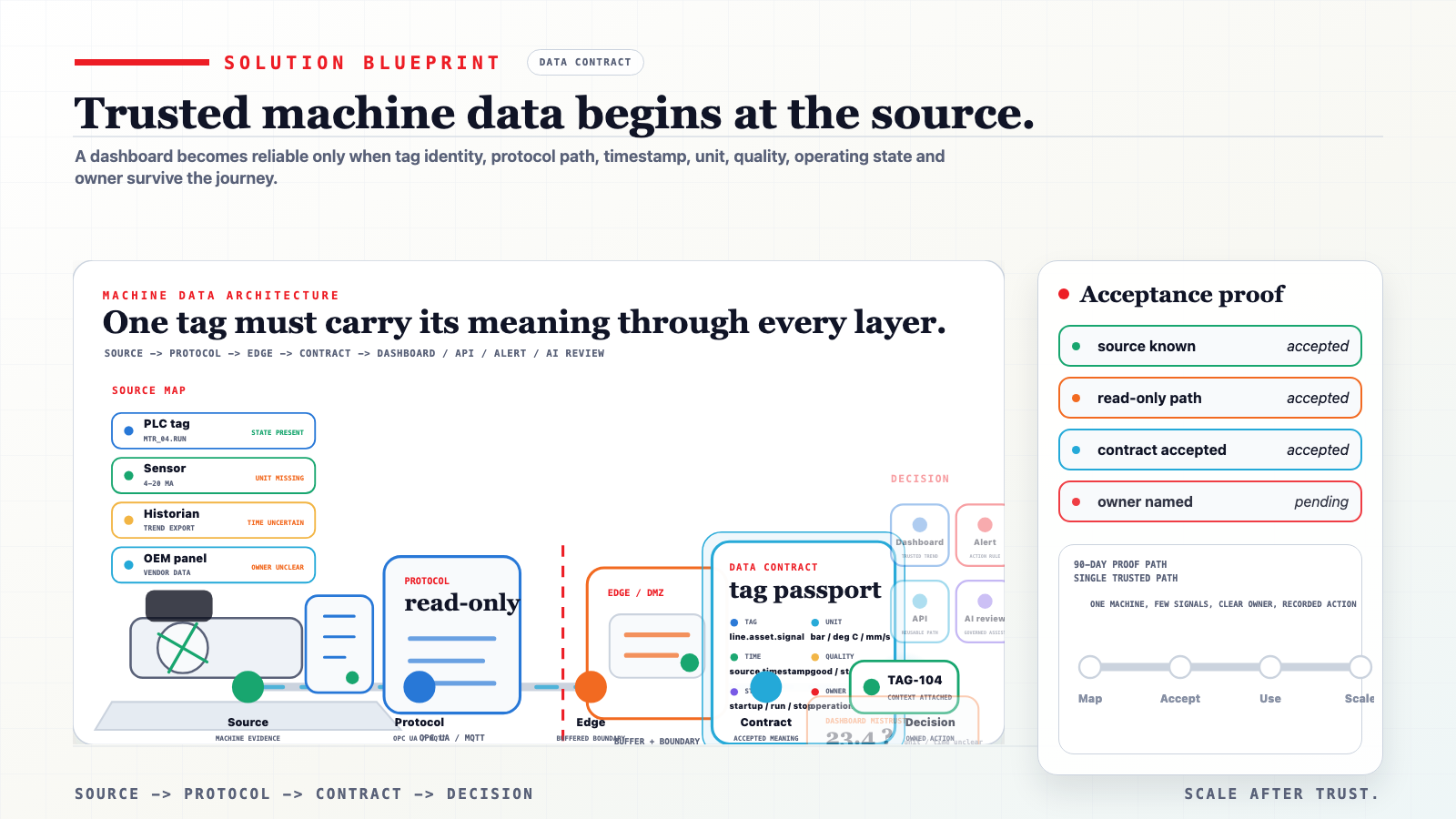
Machine data architecture from PLC and sensor sources through protocol layer, edge gateway, data contract, and decision surface
Architecture view: sources, data path, decision surface, and owner-backed action.
Solution architecture

What has to connect before scaling

Source system map Identify PLCs, sensors, historian, OEM interfaces, manual records, and existing dashboards.
Protocol layer Choose read-only OPC UA, MQTT, historian export, gateway, or API patterns based on plant constraints.
Data contract Define naming, unit, timestamp, state context, quality flag, sample need, and owner for priority signals.
Decision surface Route accepted signals into dashboards, APIs, alerts, worksheets, or AI-assist workflows only where action is clear.
30 / 60 / 90 day path

A release path that earns trust before scale

These stages are planning ranges. The real cadence depends on plant access, signal quality, risk, and ownership.

30 days

Map one data path

Pick one machine, line, utility, or asset group and document sources, protocols, owners, and decision target.

60 days

Build and accept the data contract

Connect a small set of signals, verify unit/timestamp/state quality, and agree acceptance criteria with operations.

90 days

Standardize the reusable pattern

Convert the proof path into naming, security, dashboard, and API conventions for the next line or asset group.

Required signals

The data contract is the practical proof surface.

Each signal needs ownership, unit, context, quality, and review logic. Without that contract, dashboards and alerts become fragile.

PLC or source tag Machine, tag name, owner, data type, unit, normal range, state dependency, and read-only access method.
Timestamp Timestamp source, timezone, latency expectation, sample interval, and gap behavior.
Quality flag Good, uncertain, bad, stale, manual override, maintenance mode, and disconnected behavior.
Destination Dashboard, alert, API, report, or AI review gate with action owner and retention need.
Explainer video brief

Machine Data Architecture Blueprint

Explain how trusted plant data depends on source mapping, protocol choices, data contracts, and decision surfaces.

0-6s Source reality

Useful architecture starts at the source.

6-16s Protocol path

Connectivity has to respect OT context.

16-26s Data contract

Context makes the signal useful.

26-36s Decision surface

Scale only after one trusted path works.

Related reading

Articles connected to this blueprint

Field guides and standards references that deepen the methods this blueprint depends on.
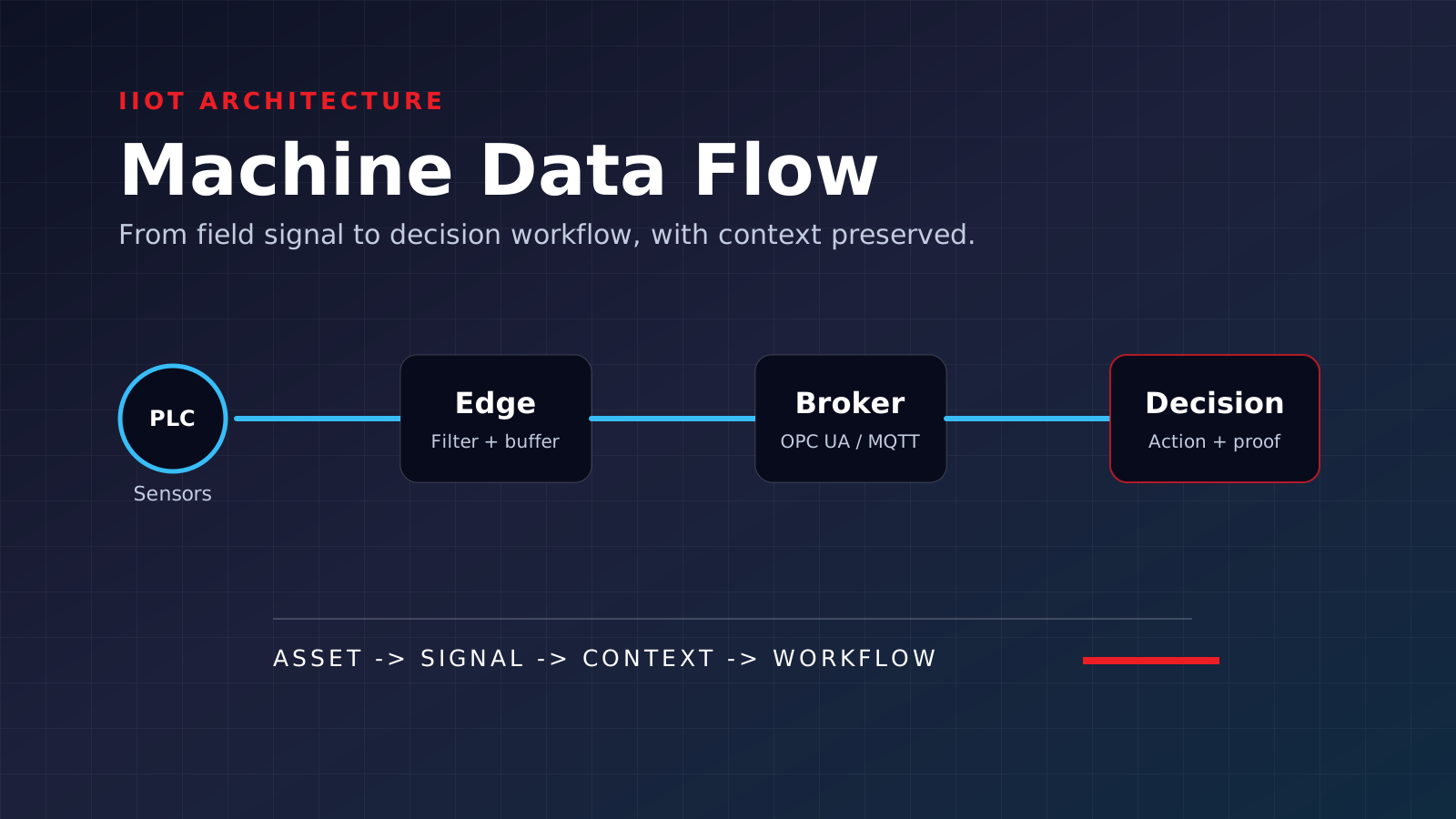
IIoT machine data flow from PLC and sensors through edge, broker, and decision workflow IIoT

IIoT Architecture For Machine Data Flow: Turning Plant Signals Into Strategic Decisions

A refined IIoT architecture guide for turning machine signals, PLC data, and sensor context into decisions that improve uptime, maintenance, energy, and production confidence.
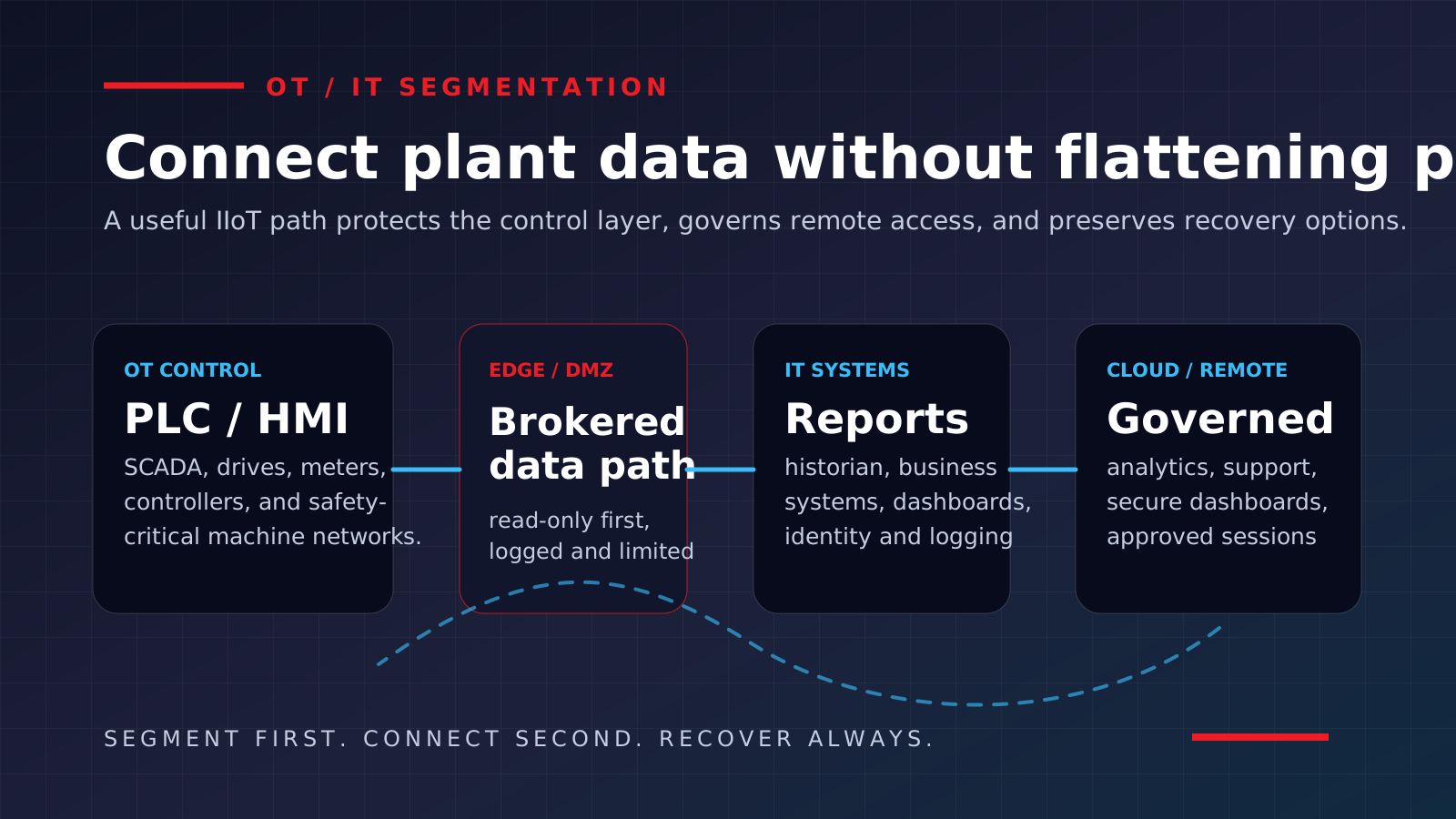
OT and IT network segmentation diagram for connected industrial plants Industrial Cybersecurity

Industrial Cybersecurity For OT And IT Networks: A Practical Guide For Connected Plants

A practical continuity-first guide for securing PLCs, SCADA, IIoT gateways, historians, cloud dashboards, and remote support paths without slowing useful modernization.
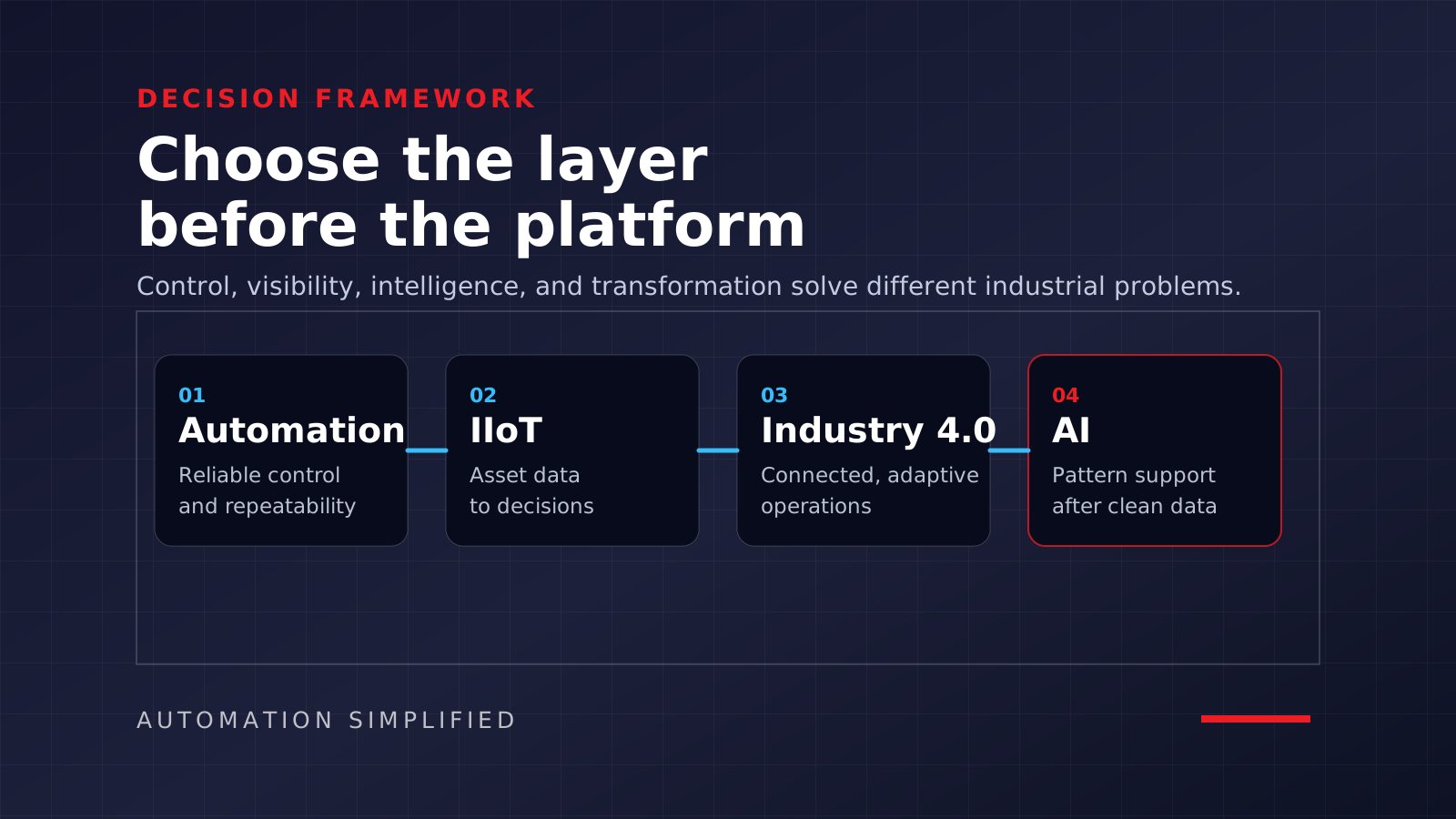
Decision framework separating industrial automation, IIoT, Industry 4.0, and AI as investment layers Industrial Automation

IoT, IIoT, Industry 4.0, And Industrial Automation: A Decision Framework For Industrial Leaders

A decision framework for industrial leaders who need to separate control, visibility, data, and transformation before committing capital.
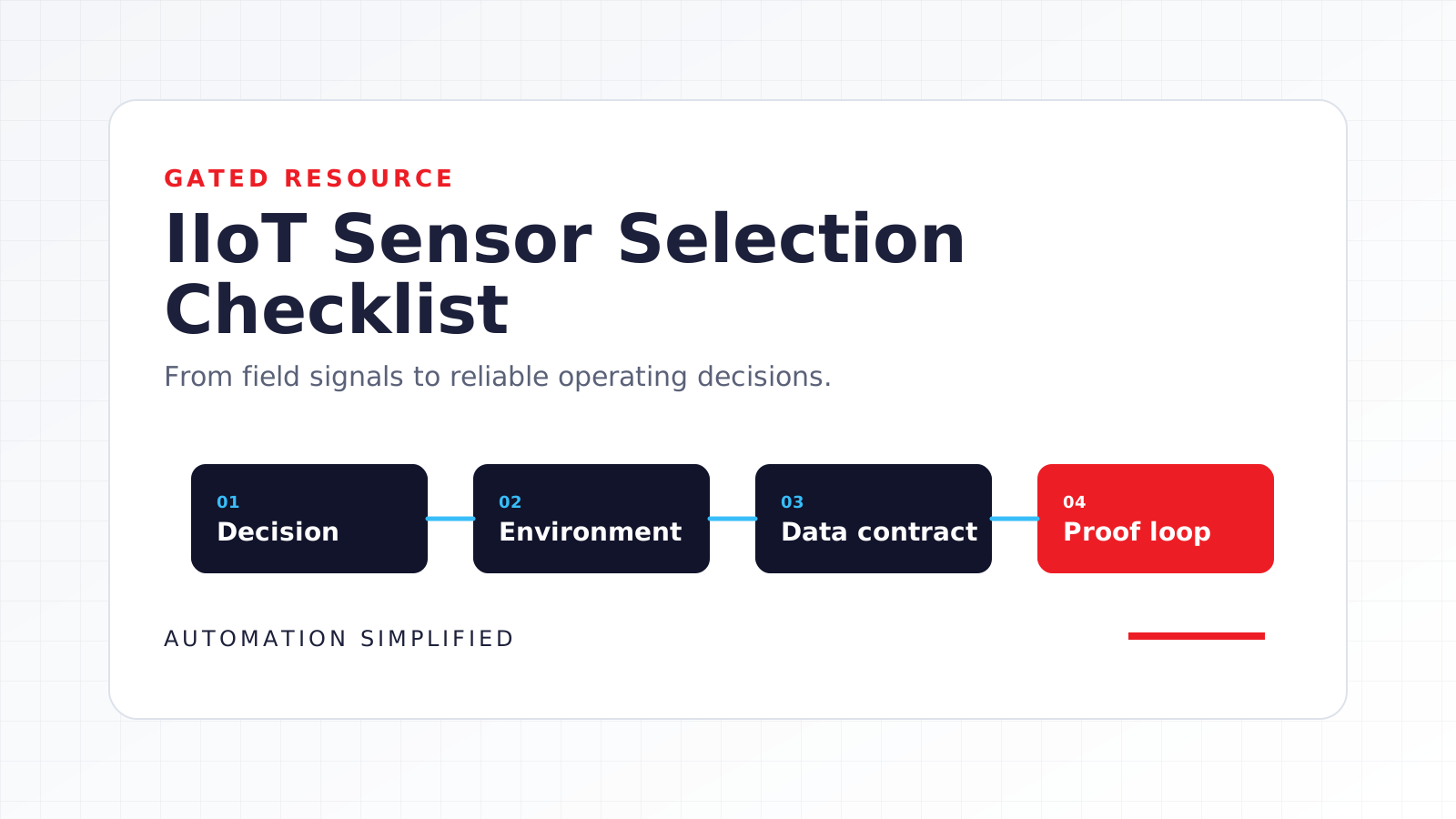
Industrial IoT sensor selection checklist resource cover IIoT

Industrial IoT Sensor Selection Checklist: From Field Signals To Reliable Decisions

A gated resource for selecting IIoT sensors, transducers, and switches that can survive the plant environment and support reliable operating decisions.
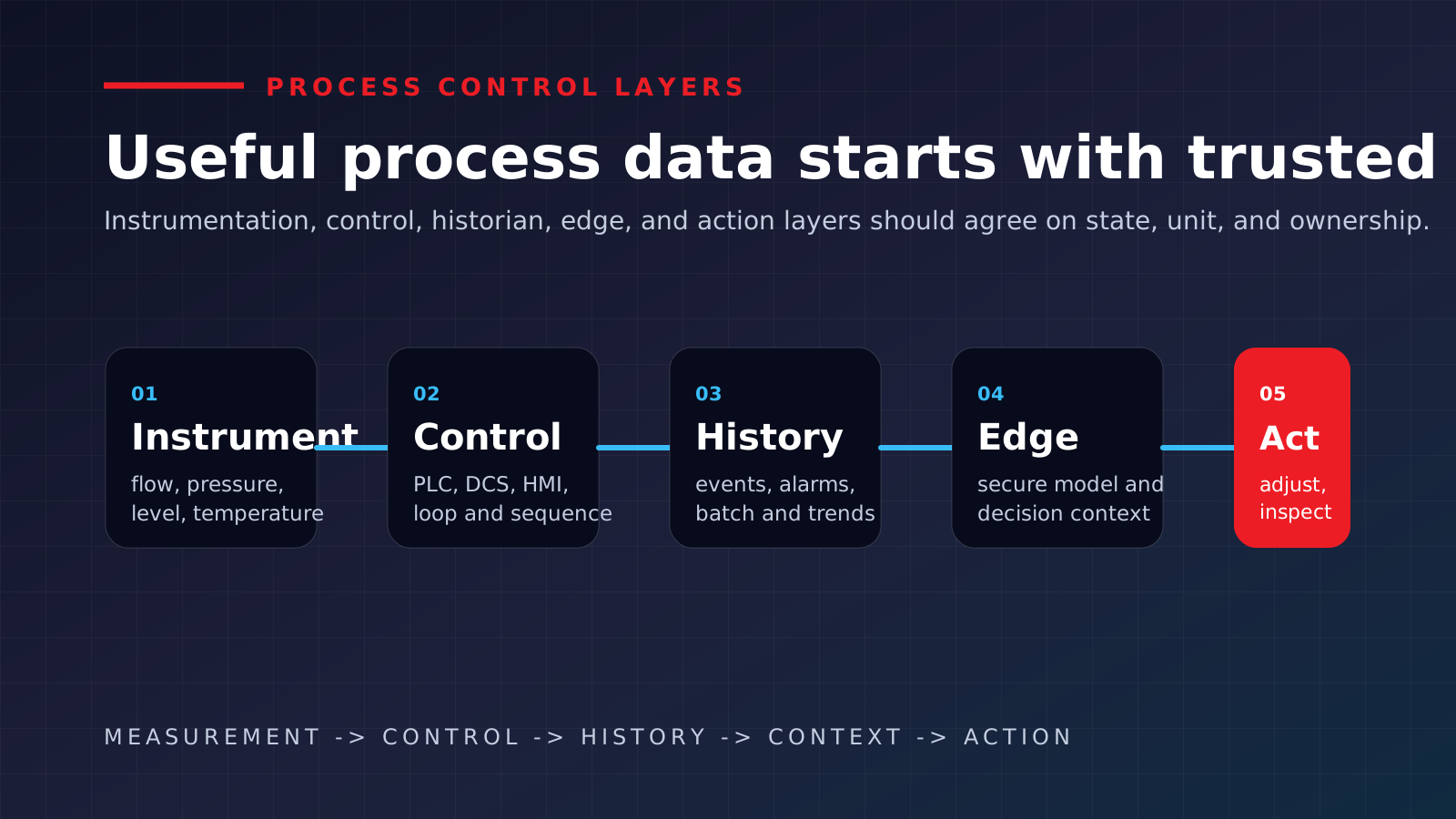
Process automation control layer diagram showing instrumentation, PLC or DCS, historian, edge, and action layers Industrial Automation

Process And Chemical Automation: Control, Visibility, And Safer Decision Workflows

A practical guide to automation and IIoT for process and chemical plants, focused on control reliability, alarms, instrumentation, maintenance, and operational visibility.
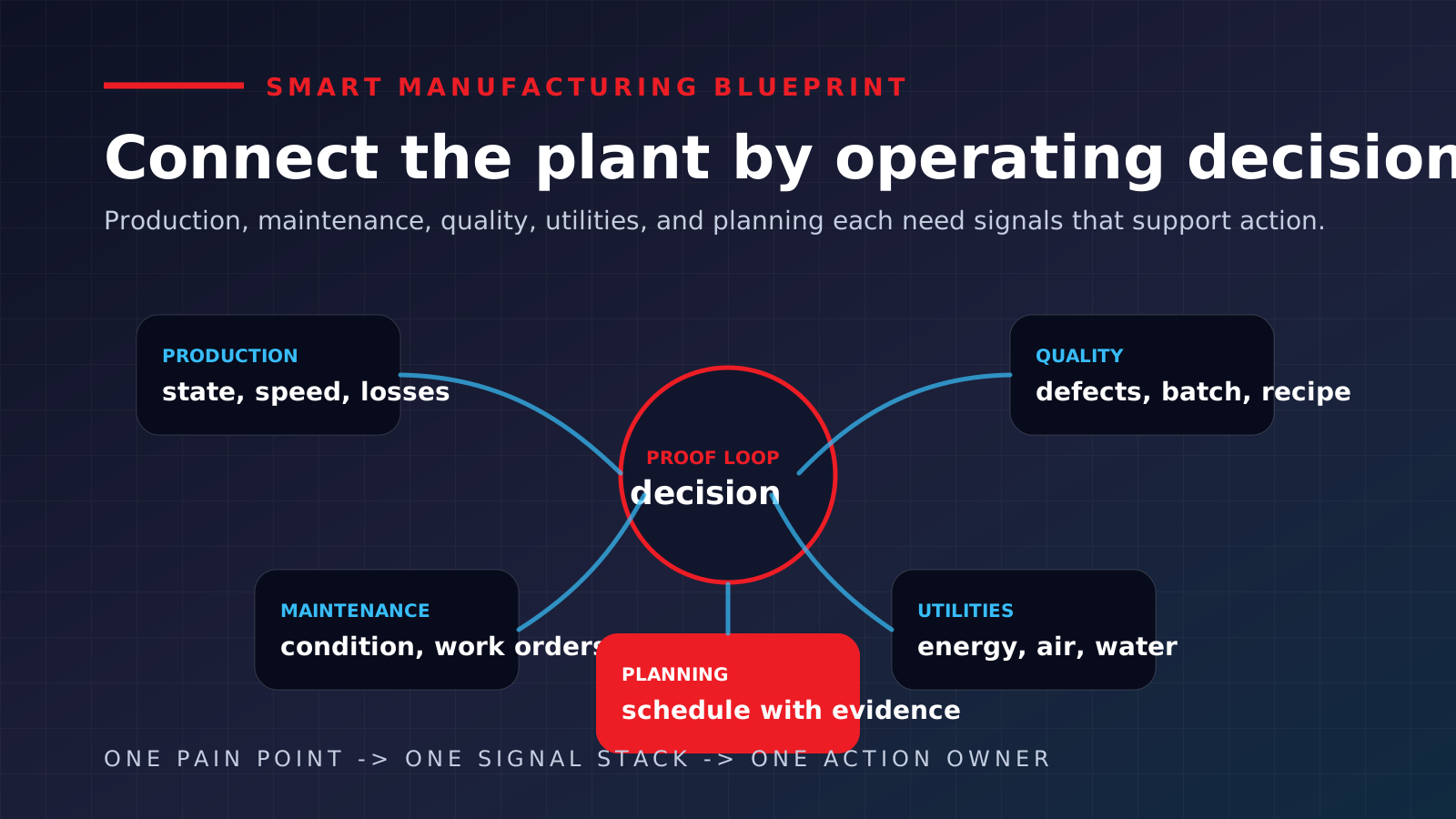
Smart manufacturing blueprint showing production, maintenance, quality, utilities, and planning connected to a decision proof loop IIoT

Smart Manufacturing With IIoT: A Practical Blueprint Before You Call It Industry 4.0

A grounded smart manufacturing blueprint for connecting production, maintenance, quality, utilities, and planning without overclaiming transformation.

Ready to see what automation could do for your plant?

Discuss Your Project