
IoT, IIoT, Industry 4.0, And Industrial Automation: A Decision Framework For Industrial Leaders
A decision framework for industrial leaders who need to separate control, visibility, data, and transformation before committing capital.

In industrial operations, the cost of a weak technology decision rarely appears as a software line item. It appears as lost hours, avoidable maintenance, delayed diagnosis, quality drift, and teams that stop trusting the systems meant to support them.
That is why the distinction between IoT, IIoT, Industry 4.0, and industrial automation matters. This is not a vocabulary issue. It is a capital-allocation issue. If a leadership team confuses automation, IIoT, and Industry 4.0, the business may invest in software before stabilizing control reliability, or replace control panels when the real constraint is production visibility.
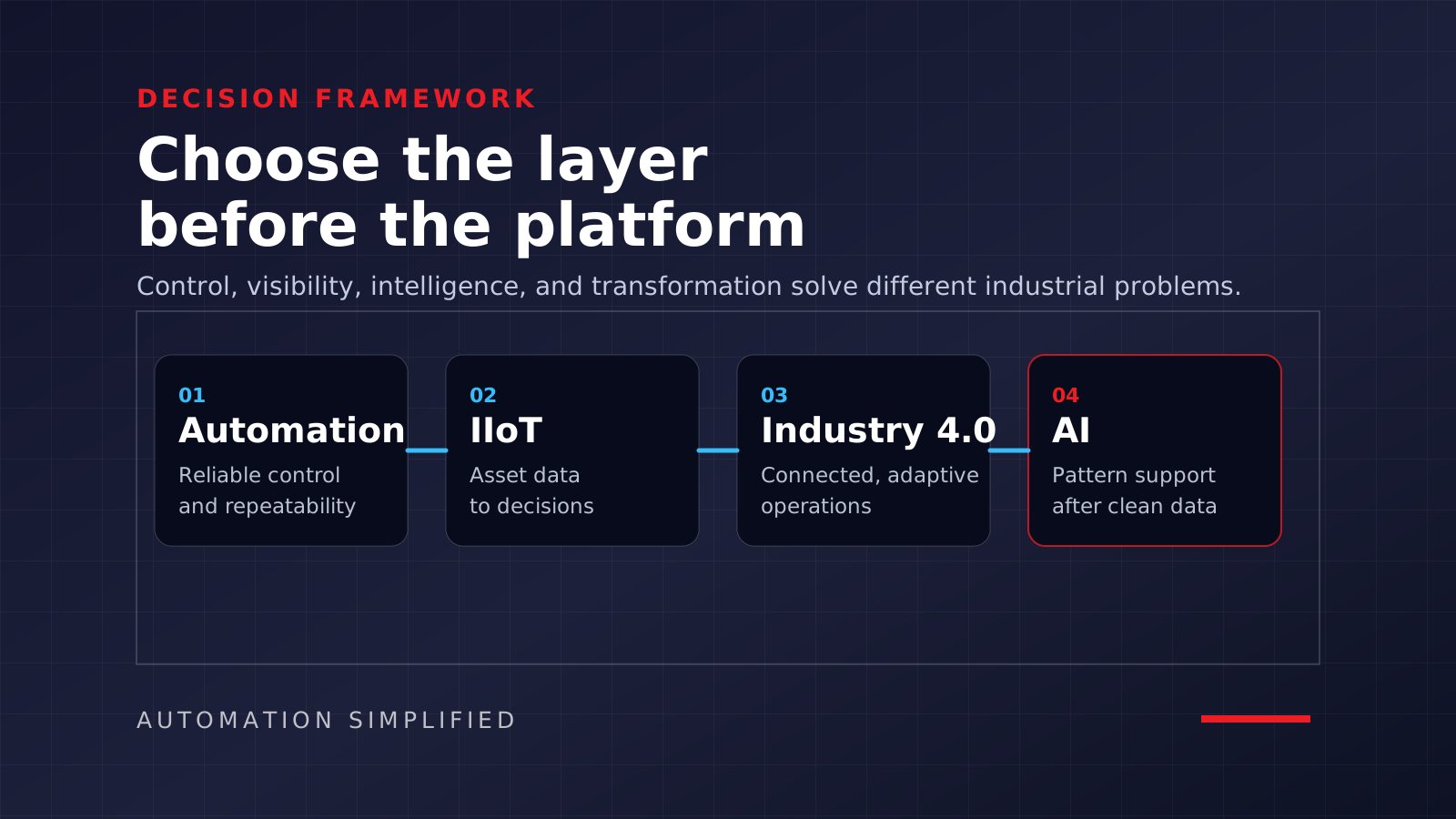
Choose the layer before choosing the platform
Stabilize control, sequencing, safety, and repeatability.
Move trusted machine data into operating decisions.
Connect production, maintenance, quality, planning, and energy systems.
Support pattern recognition only after context and governance are clear.
The cleanest way to separate them is this:
- IoT connects devices and data.
- IIoT connects industrial assets and operating decisions.
- Industry 4.0 is a broader transformation model for connected, adaptive manufacturing.
- Industrial automation controls machines and processes, often with PLCs, SCADA, drives, instruments, robots, and safety systems.
For small and mid-sized industrial companies, the goal is not to “do Industry 4.0” as a slogan. The goal is to choose the right layer for the problem: control, visibility, reliability, quality, energy, safety, or planning.
What leadership should evaluate first
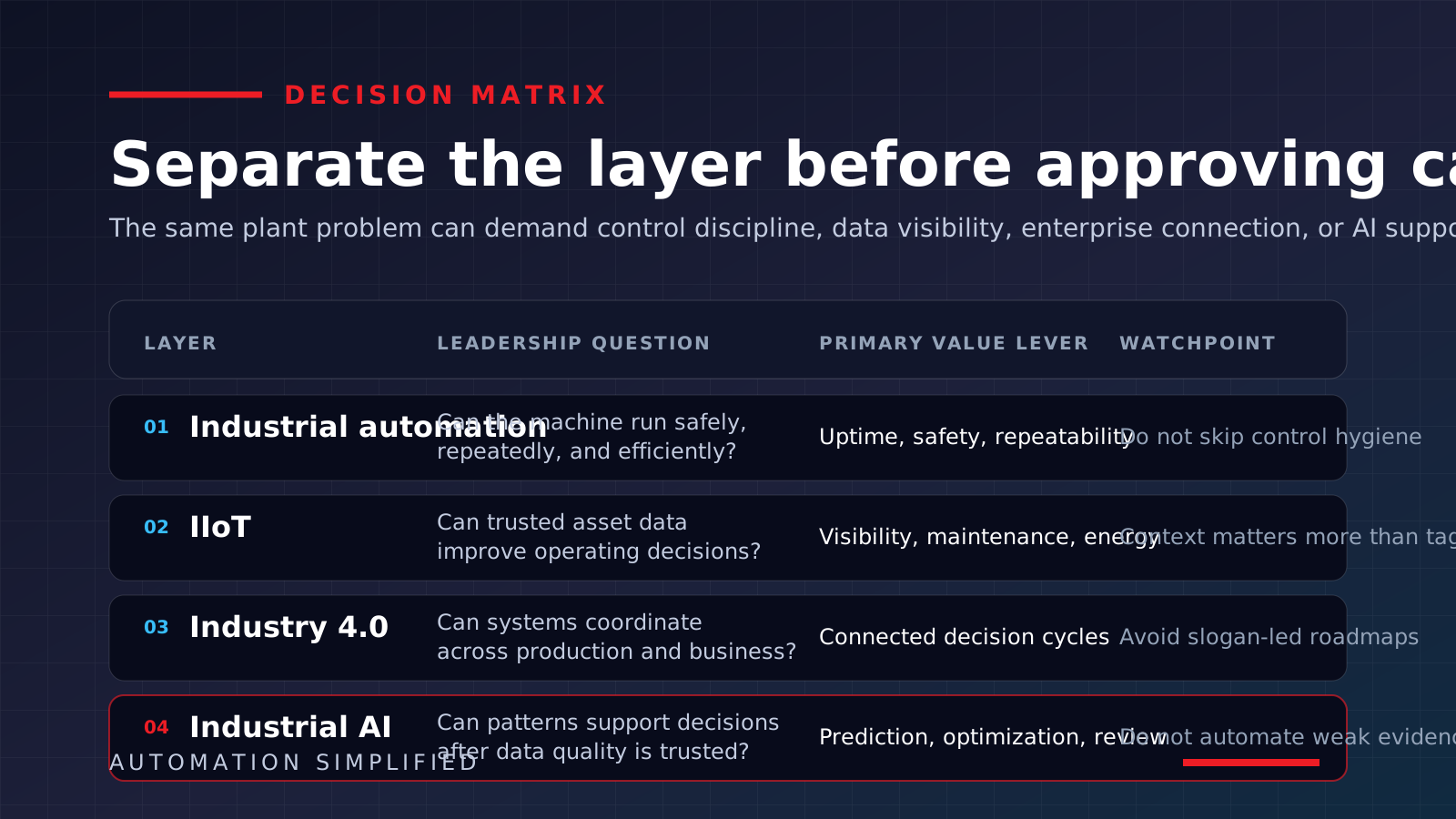
The practical value of this distinction is control over investment sequence.
| Operational constraint | Recommended first move | Primary value lever |
|---|---|---|
| Frequent machine stoppages | Industrial automation and control hygiene | Fewer stoppages, faster troubleshooting, less emergency maintenance |
| Poor visibility into line performance | IIoT data capture and event modelling | Better downtime analysis, better planning, fewer hidden losses |
| Quality variation without clear cause | Process data, batch context, and quality linkage | Less scrap, faster root cause analysis, better customer confidence |
| Maintenance surprises | Condition monitoring and predictive workflows | Better shutdown planning, fewer urgent spares, reduced firefighting |
| Competitive pressure from larger plants | Phased Industry 4.0 roadmap | Better decisions per unit of capital invested, scalable modernization |
This is the promise of a disciplined roadmap: understand the layer first, then invest.
Where modernization programs go off track
A modernization program goes off track when the investment layer does not match the operating constraint: buying a reporting layer when the plant needs control discipline, or approving a PLC upgrade when the business problem is actually visibility across machines.
For example, a packaging line with frequent stoppages may need automation hygiene first: reliable sensors, clean control logic, interlocks, alarms, and operator procedures. Adding a cloud reporting layer before fixing these foundations may only move unreliable data faster.
Similarly, a plant with stable automation but poor maintenance visibility may not need a full control-system replacement. It may need IIoT data capture from existing PLCs, vibration sensors, current sensors, or utility meters, then a clear decision workflow for the maintenance team.
How the terms map to plant reality
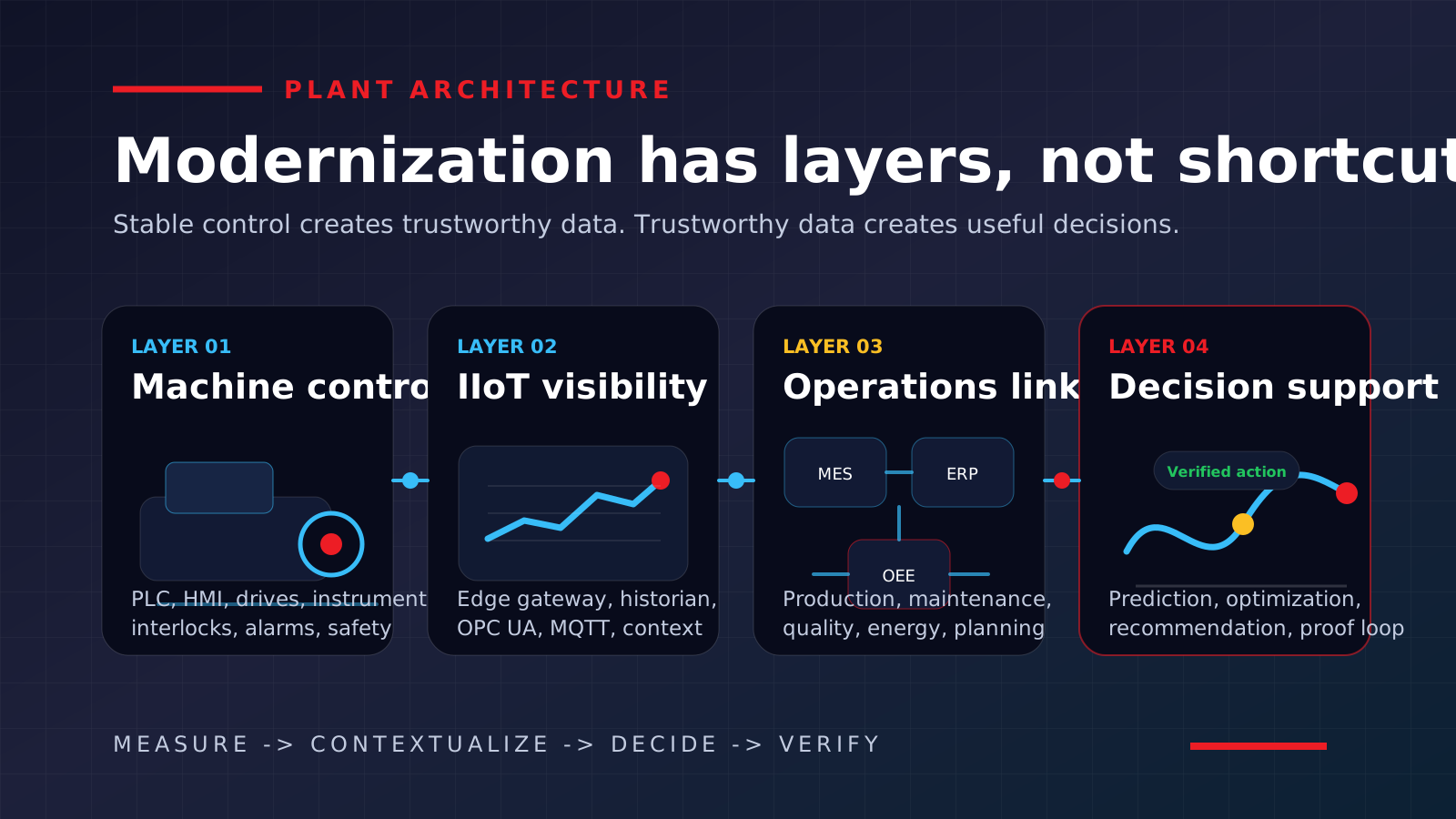
| Modernization layer | Operating question | Typical technologies | Practical plant outcome |
|---|---|---|---|
| IoT | Can a device send useful data? | Sensors, connectivity, cloud apps, mobile apps | Remote visibility and device-level monitoring |
| IIoT | Can plant equipment data improve operating decisions? | PLC data capture, industrial gateways, OPC UA, MQTT, historians, edge compute | Better maintenance, energy, quality, and production visibility |
| Industry 4.0 | Can the factory become connected, adaptive, and data-driven? | IIoT, MES/ERP integration, digital twins, analytics, robotics, AI | Connected operations and improved decision cycles |
| Industrial automation | Can the machine or process run safely, repeatedly, and efficiently? | PLC, SCADA, HMI, VFDs, instruments, safety relays, robots | Stable control, repeatability, safety, throughput |
OPC UA and MQTT can support industrial data movement, while ISA-95 is a useful reference when connecting control, operations, and business context. NIST’s smart manufacturing work is also a useful reminder that connected operations require models, measurement, and analysis discipline. But protocols and models should follow the operating problem, not lead it.
Industrial automation is not outdated because IIoT exists. In most real plants, IIoT becomes useful only when the automation layer is reliable.
Three decision tests before investment
1. Is the issue control or visibility?
If the machine does not run consistently, control must come first. That may mean PLC logic cleanup, wiring correction, sensor replacement, alarm rationalization, or operator workflow changes.
If the machine runs, but the team does not know why output, rejects, downtime, or energy cost changes, visibility may be the first project. That is where IIoT, historian data, operating-state models, and event capture help.
2. Is the data trustworthy?
Data is not useful just because it is digital. Industrial data needs context: asset name, timestamp, operating state, batch, product code, speed, load, maintenance state, and sensor health.
Without context, analytics can mislead. A motor current spike during startup is normal. The same spike during steady operation may need investigation.
3. Does the project change a decision?
Every IIoT or Industry 4.0 project should map to a decision:
- Stop the line or continue?
- Schedule maintenance now or next shutdown?
- Reduce speed, change recipe, inspect tooling, or replace a bearing?
- Escalate an alarm or suppress it as nuisance?
- Invest in automation, instrumentation, or training?
If the project does not change a decision, it may become an expensive screen.
Economic value model
Do not justify a project using generic claims like “Industry 4.0 improves productivity.” Estimate the value from the specific loss you want to reduce.
Annual loss from one recurring problem =
frequency per year
x average hours lost
x contribution margin or production value per hour
+ emergency maintenance cost
+ scrap/rework/quality cost
+ customer or dispatch impact where applicableEstimate the value at risk before selecting the technology layer
Use this as a planning estimate, not a published ROI claim. Replace default values with plant-specific contribution margin, downtime history, and implementation cost during discovery.
Estimated annual value at risk before improvement.
This calculator uses values entered by the reader. It is not a case-study result, savings guarantee, or financial advice.
The calculator is a planning estimate, not a published customer result. During discovery, the inputs should be replaced with plant-specific contribution margin, downtime history, and implementation cost.
A practical roadmap for industrial companies
- 01 Stabilize the automation base
Review sensors, panels, grounding, PLC logic, alarm quality, HMI usability, documentation, and backups.
- 02 Capture high-value data
Prioritize signals tied to business pain: downtime, rejects, energy use, condition data, or changeover loss.
- 03 Connect through industrial protocols
Use OPC UA, MQTT, historians, or edge systems where they fit the plant environment and security model.
- 04 Build the decision workflow
Connect signals to maintenance work orders, escalation rules, quality checks, or production reviews.
- 05 Expand after the first loop works
Scale by asset group, line, utility, or plant only after the first proof loop is operational.
How to decide the first project
The best first project is rarely the one with the most impressive screen. It is the one where the business pain, data source, decision owner, and action path are all visible.
A stronger first project has loss, data, ownership, action, and proof
Use this scorecard before approving budget:
| Decision checkpoint | Credible response | High-risk response |
|---|---|---|
| Loss to reduce | Downtime, scrap, utility waste, emergency maintenance, slow diagnosis | Vague transformation objective |
| Existing data baseline | PLC tags, alarms, work orders, meter data, downtime logs | Discovery deferred until after spend |
| Signal owner | Named maintenance, production, quality, or energy owner | No operating owner defined |
| Action after alert | Inspection, setpoint review, maintenance job, operator action | Visibility with no action path |
| Value verification method | Before/after loss or response-time comparison | Generic ROI estimate without operating evidence |
This scorecard prevents the common failure mode: technology is installed, but no one is accountable for using it.
Watchouts before committing budget
- Buying a platform before defining the operating problem.
- Assuming AI can compensate for poor instrumentation.
- Sending every tag to the cloud without a security and data-governance model.
- Treating visualization as transformation.
- Ignoring maintenance and operator adoption.
- Underestimating old machines, legacy PLCs, and undocumented panels.
The Industry Digits view
For industrial businesses, automation and IIoT should not be presented as fashion. They are engineering tools for building operational resilience. The work is to simplify a complex plant into reliable control, trustworthy signals, and clear decisions.
The right first project is usually not the biggest one. It is the one that proves the loop:
measure -> understand -> decide -> act -> verify.
When that loop works, Industry 4.0 stops being a slogan and becomes an operating advantage.
Lokesh Chennuru writes Industry Digits field notes for industrial decision makers, focused on automation, IIoT, condition monitoring, predictive maintenance, and industrial AI.
Connect on LinkedInQuestions industrial leaders ask about this
What is the difference between IoT, IIoT, and Industry 4.0?
IoT connects devices and data, IIoT connects industrial assets to operating decisions, Industry 4.0 is the broader transformation model, and industrial automation controls machines and processes. They are layers in a stack, not synonyms.
Which layer should a plant invest in first?
The one that matches the problem. Frequent stoppages point to automation and control hygiene, poor visibility points to IIoT data capture, and competitive pressure points to a phased Industry 4.0 roadmap. The sequence follows the loss you want to reduce.
Is industrial automation outdated now that IIoT exists?
No. In most plants IIoT becomes useful only when the automation layer is reliable, because analytics inherit the quality of the control and signal layer beneath them.
Ready to turn signals into a maintenance decision path?
Book a 30-minute consultation and we will map the fastest useful condition-monitoring or automation win.