
Book a Consultation
HomeServicesCritical Asset Monitoring
Predictive Maintenance now maps to

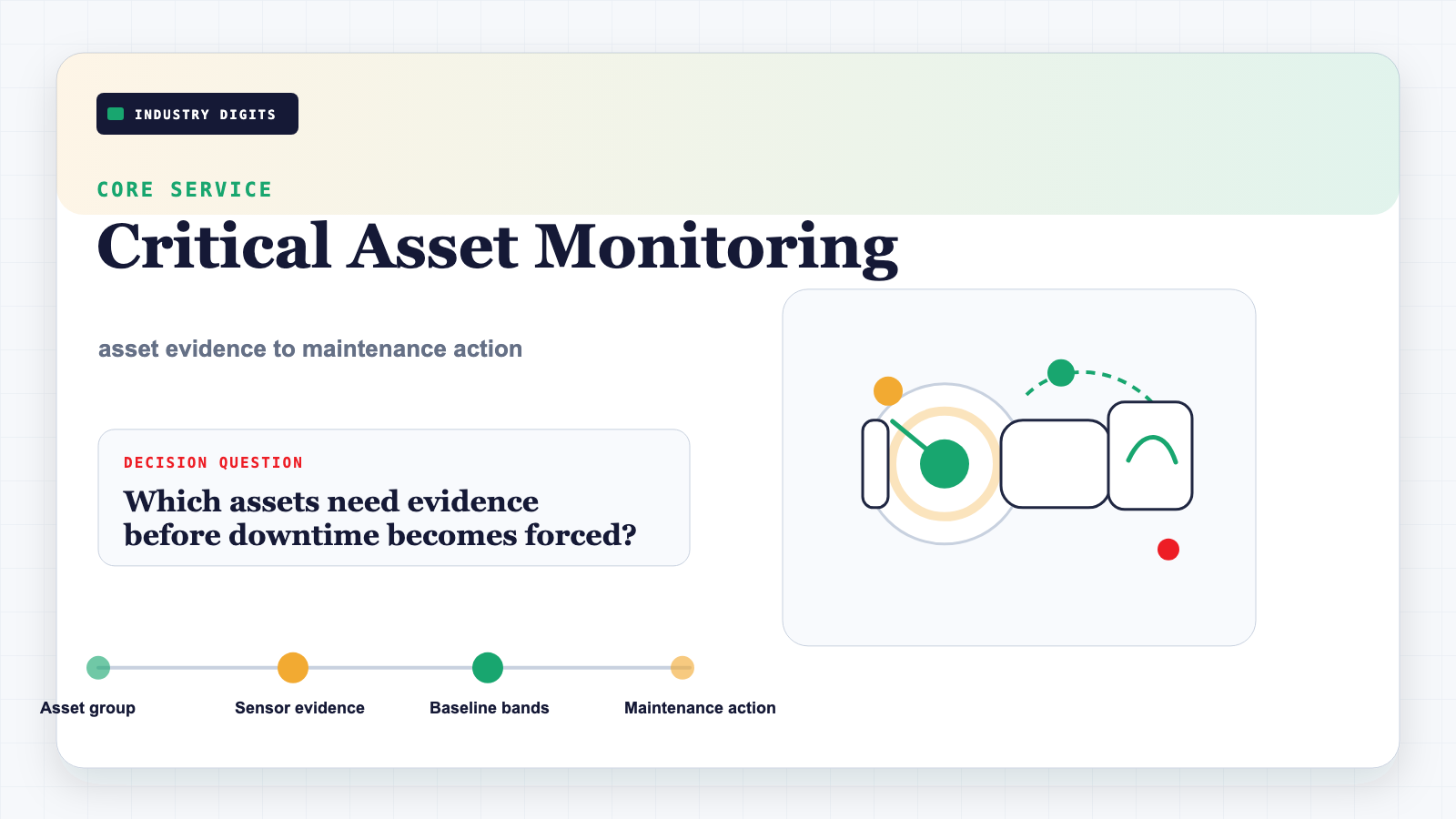
Critical Asset Monitoring

Monitoring programs for bearings, motors, pumps, gearboxes, and utilities where early evidence must become a maintenance decision.

Service promise

Turn vibration, temperature, current, lubrication, and operator evidence into a watchlist your maintenance team can actually act on.

A few assets repeatedly threaten production continuity or quality.
Existing alarms are noisy, disconnected from work planning, or too late.
Leadership needs a bounded pilot before investing in wider condition monitoring.
Discuss a monitoring pilot
Wireframe-style rotating asset monitoring scene with vibration, temperature, and maintenance action signals
Implementation method

What we actually build and verify

Each service starts from a bounded operating decision, then defines the technical path needed to support it.

01

Criticality first

Rank the asset group by downtime consequence, safety or quality exposure, repeat failure history, and maintenance access constraints.
02

Signal selection

Choose vibration, temperature, current, oil or process signals only where they support a known failure mode and action window.

03

Baseline and bands

Separate normal operating states from watch, inspect, plan, and alarm bands so the team knows when evidence deserves action.

04

Action workflow

Connect each threshold or trend change to a maintenance owner, verification step, and planning decision before dashboard rollout.
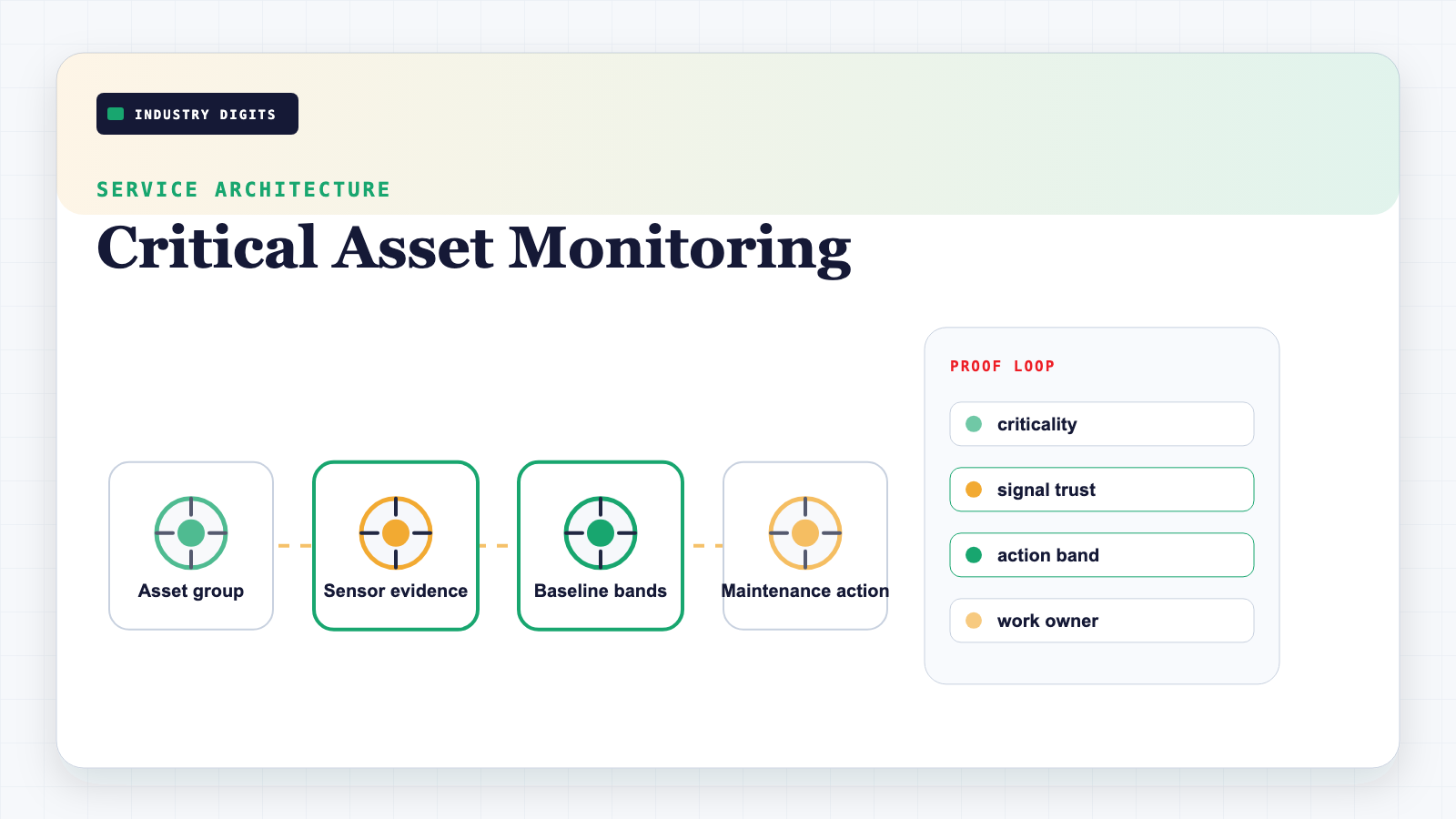
Critical asset monitoring architecture from asset hierarchy through sensors, baseline, action bands, and work planning
Evidence needed

Useful scope starts with field evidence.

Asset hierarchy Critical machines, asset tags, bearing or motor details, operating duty, and process conditions that affect signal meaning.
Failure modes Known failure history, suspected degradation paths, inspection findings, lubrication context, and spares or outage constraints.
Signal quality Sensor type, mounting point, sampling interval, units, timestamp quality, and the operating state present when data is captured.
Maintenance ownership Who reviews alerts, who verifies the asset, who schedules work, and which evidence is required before intervention.
First engagement

A bounded pilot before a plant-wide program.

Start with one asset group, one signal strategy, and one decision review window.

Select one asset group Start with a bearing line, motor group, pump train, compressor, fan, gearbox, or utility asset where decision value is visible.
Instrument the minimum useful signal set Capture enough evidence to distinguish normal variation from a condition change, without creating an unmaintainable sensor estate.
Run a decision review window Review trends with maintenance and operations for a fixed period, tune thresholds, and document the first actionable patterns.
Decide scale, hold, or stop Use field feedback and alert quality to decide whether the method should expand, stay focused, or be redesigned.
Explainer video brief

Predictive Maintenance: Forecast To Maintenance Timing

Explain predictive maintenance as a decision method: measured machine behaviour, forecast confidence under comparable operating state, and a practical timing change for inspection, spares, or controlled shutdown.

0-6s Prediction must change timing

Prediction is useful only when it changes the maintenance date.

6-16s Trend plus state

A trend without comparable state is a weak forecast.

16-28s Decision window

The useful output is inspection timing, spare planning, or a controlled shutdown window.

28-36s Controlled action

Predictive maintenance protects the decision before it predicts the failure.

Related reading

Field guides that deepen this service

Standards-anchored articles on the methods this service uses — signal selection, thresholds, data paths, and the review workflows that turn evidence into action.
5 Bearing Failure Signals: How To Catch Critical Asset Risk Before The Line Stops Predictive Maintenance

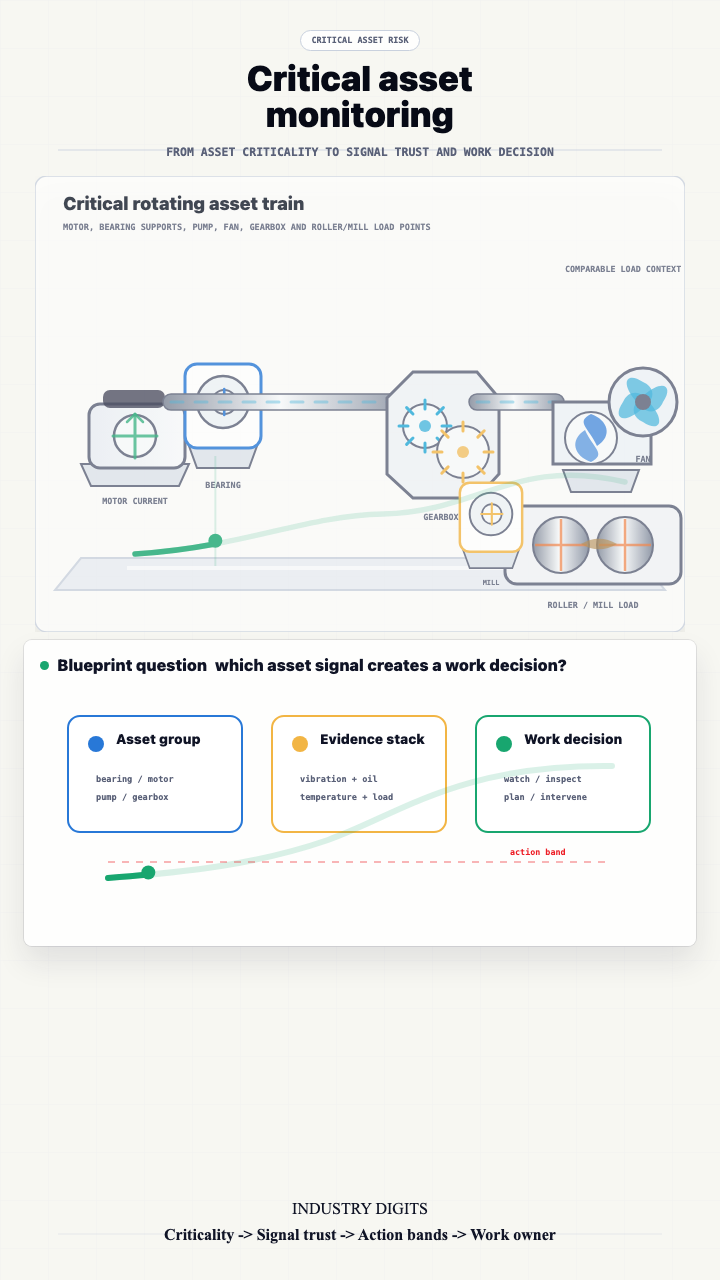
5 Bearing Failure Signals: How To Catch Critical Asset Risk Before The Line Stops

A practical field guide for using vibration, temperature, current, lubrication evidence, and operator observations to turn bearing risk into planned maintenance action.
Decision tree comparing vibration, temperature, and current as first condition monitoring signals Condition-Based Monitoring

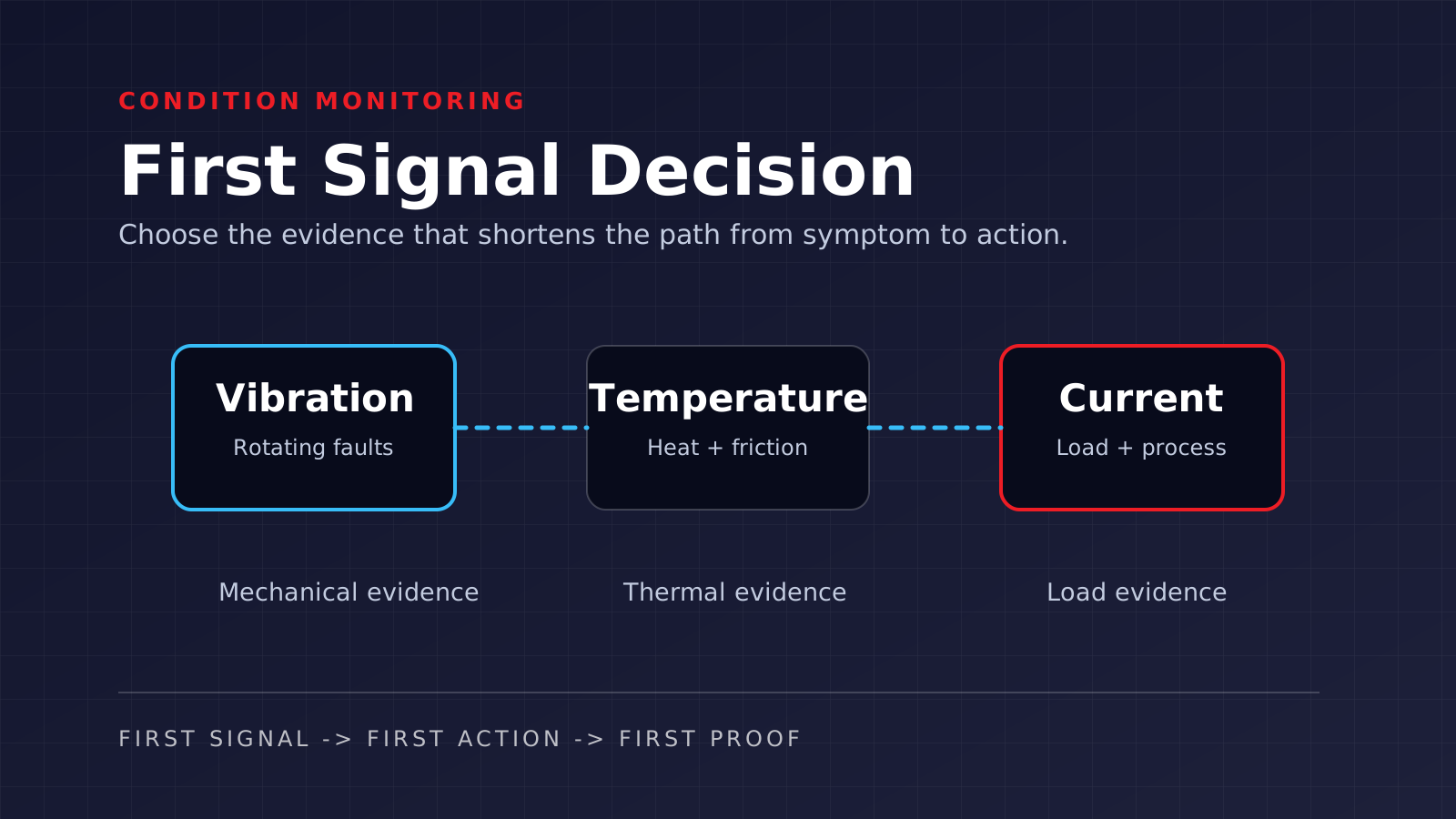
Thermal, Vibration, Or Current: Choosing The First Signal That Earns Trust

A condition monitoring decision guide for choosing the first signal that builds trust, protects maintenance capacity, and gives earlier warning on critical assets.
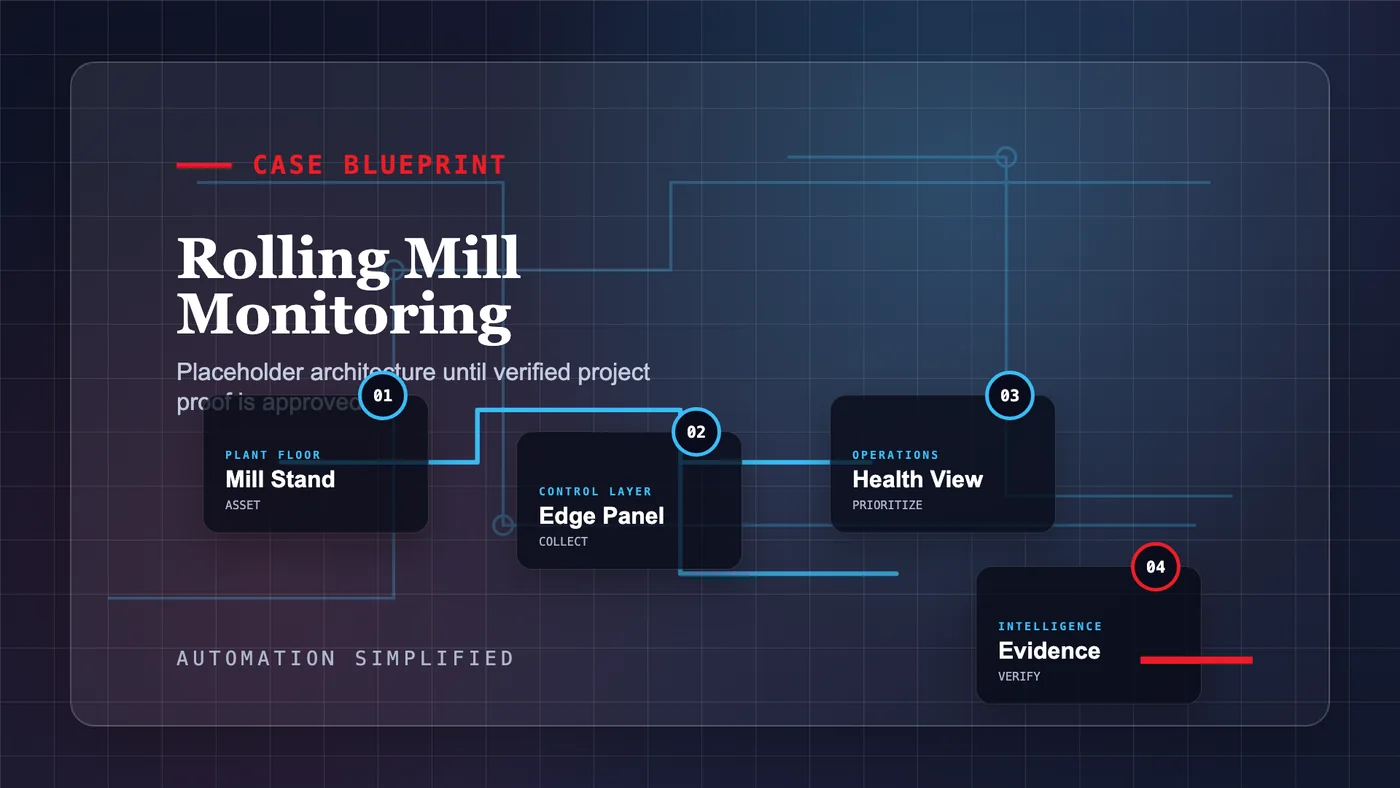
Technical blueprint of a rolling mill monitoring case with bearing signals and process context Condition-Based Monitoring

Journal Bearing Monitoring In Sheet Metal Rolling Lines

A technical review of journal-bearing monitoring in sheet metal reduction lines, connecting roll force, viscosity, lubricant feed condition, oil cleanliness, temperature, vibration, and maintenance action.
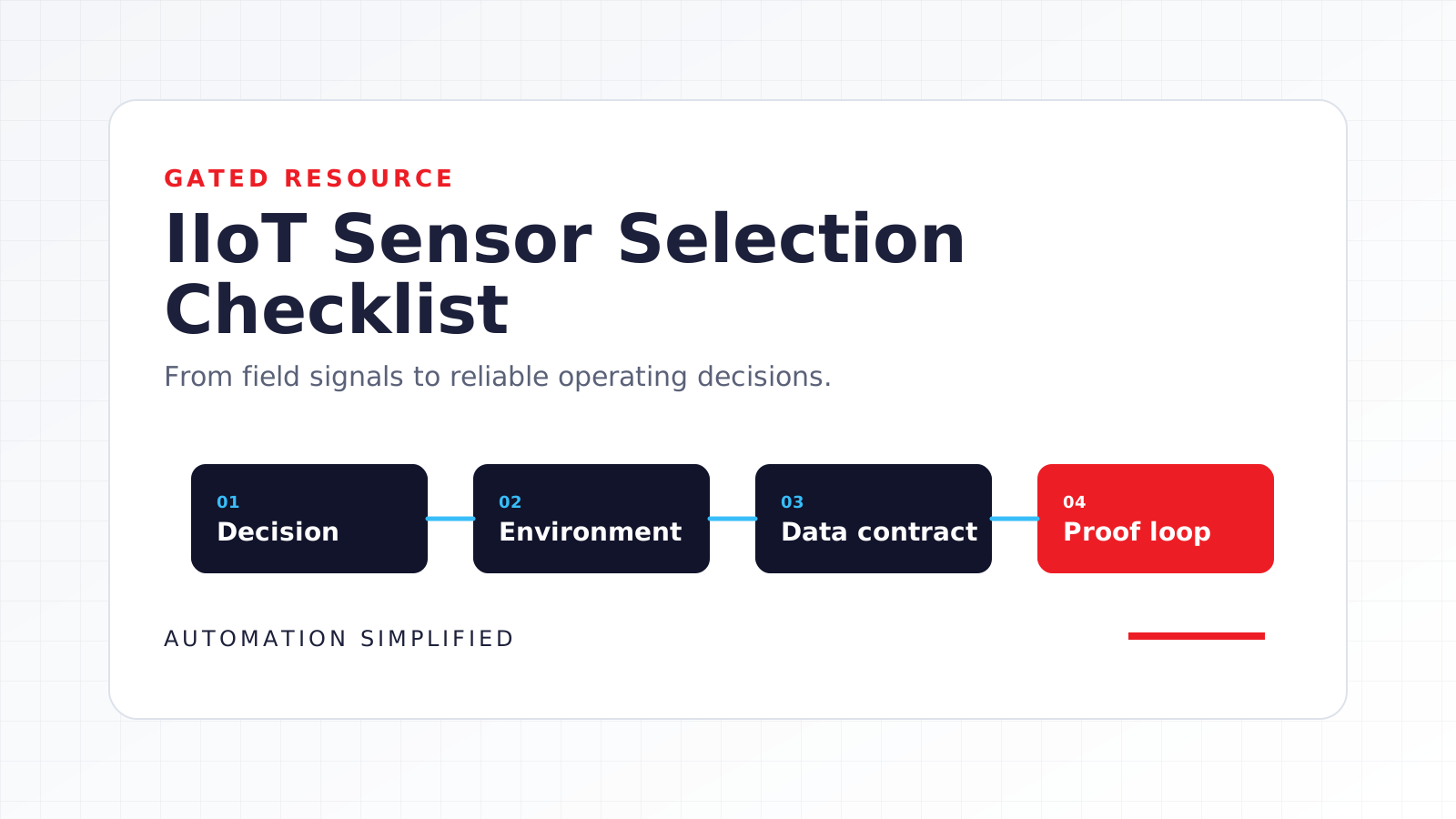
Industrial IoT sensor selection checklist resource cover IIoT

Industrial IoT Sensor Selection Checklist: From Field Signals To Reliable Decisions

A gated resource for selecting IIoT sensors, transducers, and switches that can survive the plant environment and support reliable operating decisions.
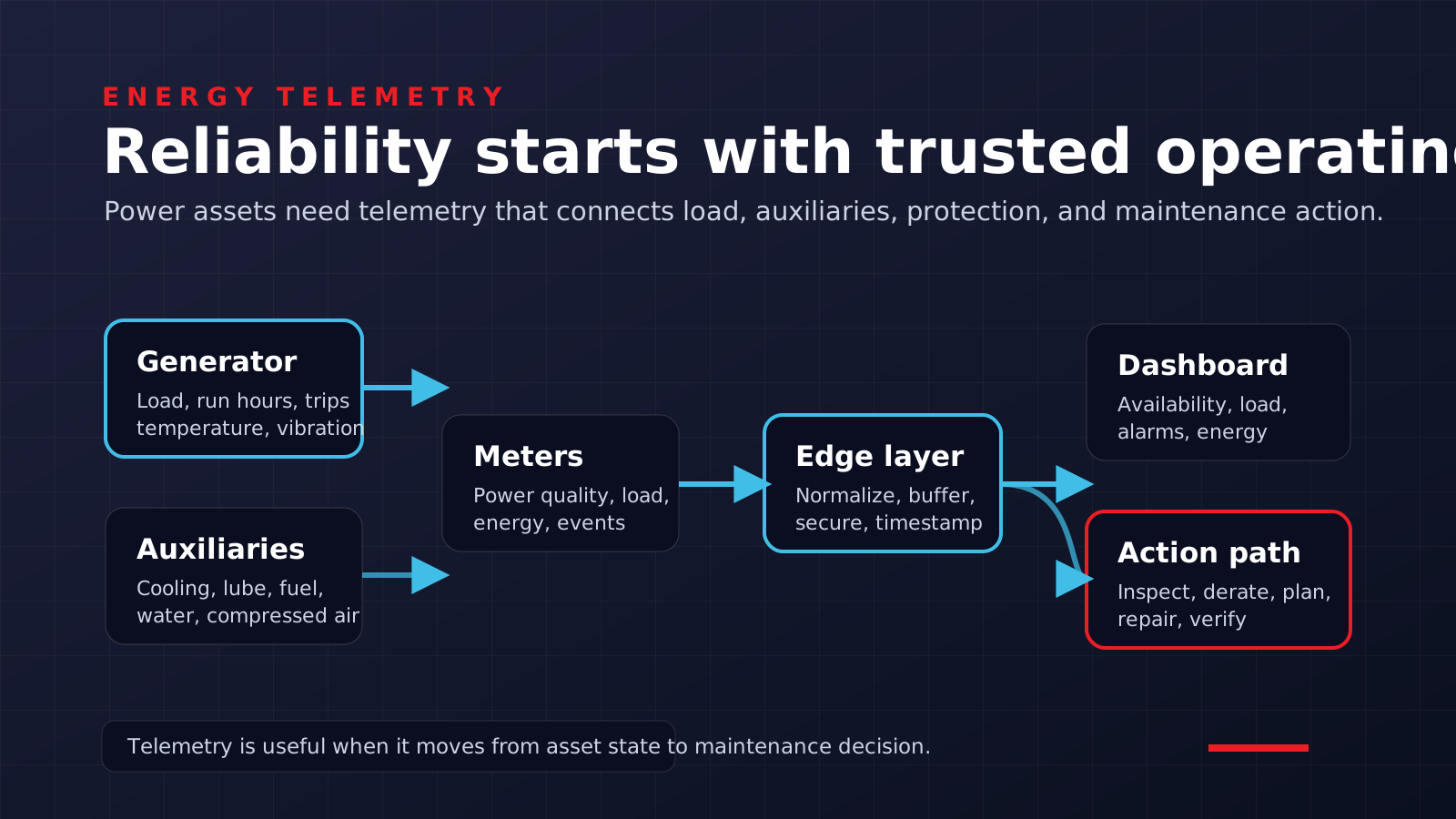
Power generation telemetry architecture connecting generator, auxiliary systems, meters, edge gateway, dashboard, and maintenance action Energy & Power

Power Generation Automation And IIoT: Reliability, Telemetry, And Maintenance Decisions

A practical reliability guide for power generation and energy assets where automation, IIoT telemetry, and condition monitoring must protect continuity.
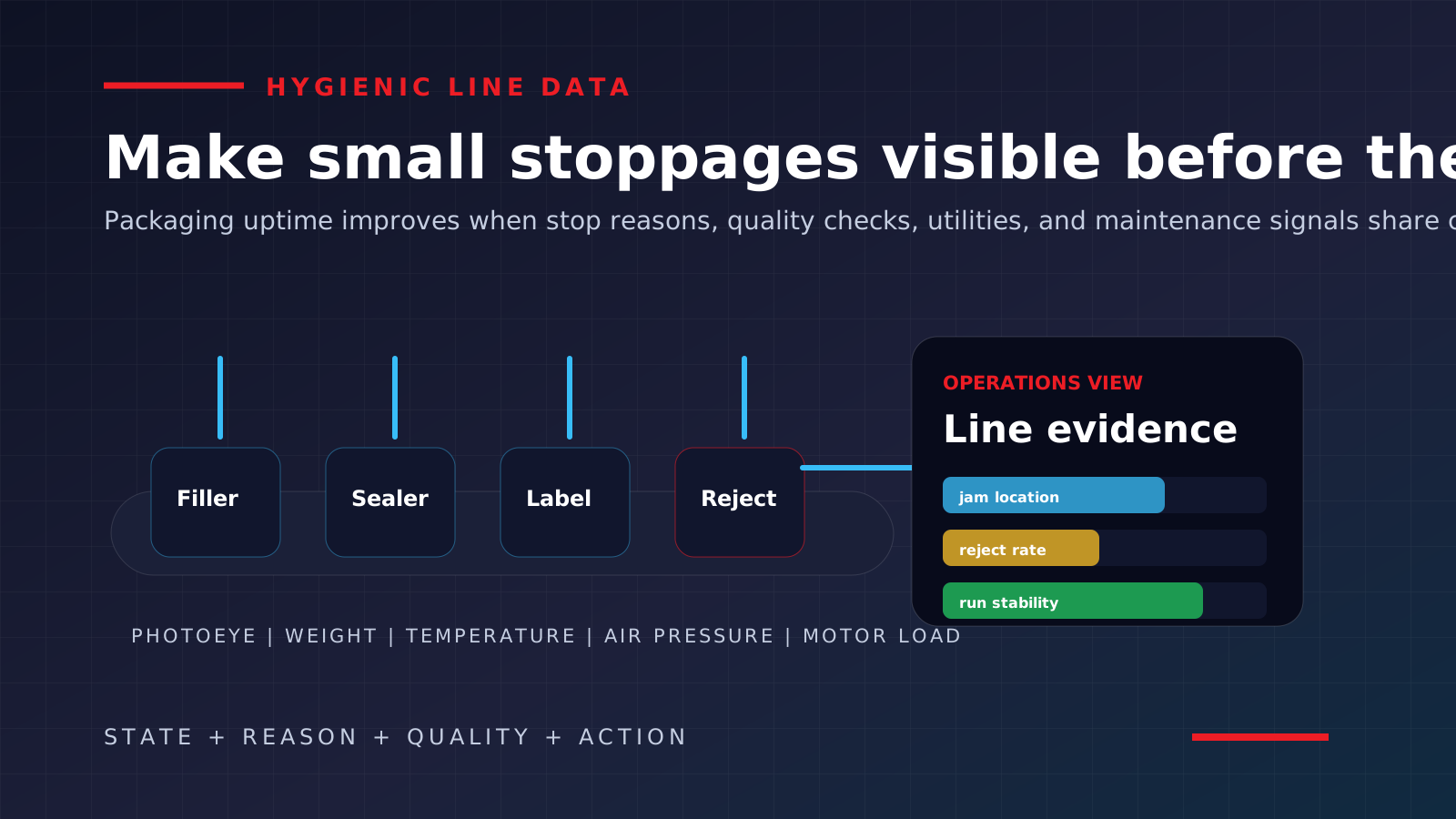
Food and beverage packaging line data flow diagram showing sensors, PLC states, quality checks, and dashboard evidence Industrial Automation

Food And Beverage Automation: Practical IIoT And Control Ideas For Hygienic Production Lines

How food and beverage plants can use automation, IIoT, and condition monitoring to improve uptime, hygiene, quality, and packaging reliability without overcomplicating operations.

Ready to see what automation could do for your plant?

Discuss Your Project