

Book a Consultation
HomeCapability HubsMaintenance Action Workflows
Capability hub

Maintenance Action Workflows

Turn condition signals, alarms, inspections, and failure-mode evidence into maintenance decisions teams can actually execute.

60 seconds
Explainer brief
5
Linked articles
4
Related paths
Decision lens

When a signal changes, who verifies it, who plans the work, and what operating window does the team protect?

Maintenance Action Workflows closes the gap between monitoring and action. It defines inspection triggers, escalation rules, planning windows, watch lists, and review loops so signals do not become dashboard noise.

Wireframe of asset evidence moving through failure modes into a work plan
Alarm-to-action workflow
Explainer video brief

From signal noise to maintenance action

Show that useful maintenance intelligence depends on action design, not more disconnected alerts.

01
0-12s

Alert noise

Visual: Multiple asset alerts arrive without owner, priority, or operating state.

More alerts do not automatically create better maintenance.

02
12-28s

Failure-mode context

Visual: Alert attaches to failure mode, asset criticality, and operating window.

The same signal means different things under different operating conditions.

03
28-45s

Inspection and escalation

Visual: Inspection card confirms, escalates, or returns the signal to watch status.

A bounded pilot separates real risk from noise.

04
45-60s

Work planning

Visual: Risk card becomes scheduled work with owner, window, and reset baseline.

The outcome is maintenance capacity protected by better decisions.

Research in this hub

Articles and field notes that converge on this decision

Each piece below is selected because it sharpens the same operating question — not because it shares a keyword.

Predictive Maintenance

5 Bearing Failure Signals: How To Catch Critical Asset Risk Before The Line Stops

A practical field guide for using vibration, temperature, current, lubrication evidence, and operator observations to turn bearing risk into planned maintenance action.

Read article
Condition-Based Monitoring

Thermal, Vibration, Or Current: Choosing The First Signal That Earns Trust

A condition monitoring decision guide for choosing the first signal that builds trust, protects maintenance capacity, and gives earlier warning on critical assets.

Read article
Condition-Based Monitoring

Journal Bearing Monitoring In Sheet Metal Rolling Lines

A technical review of journal-bearing monitoring in sheet metal reduction lines, connecting roll force, viscosity, lubricant feed condition, oil cleanliness, temperature, vibration, and maintenance action.

Read article
Industrial Automation

Food And Beverage Automation: Practical IIoT And Control Ideas For Hygienic Production Lines

How food and beverage plants can use automation, IIoT, and condition monitoring to improve uptime, hygiene, quality, and packaging reliability without overcomplicating operations.

Read article
Energy & Power

Power Generation Automation And IIoT: Reliability, Telemetry, And Maintenance Decisions

A practical reliability guide for power generation and energy assets where automation, IIoT telemetry, and condition monitoring must protect continuity.

Read article
What this hub maps

Alarm-to-action workflow

  1. Signal change
  2. Inspection trigger
  3. Risk priority
  4. Scheduled work

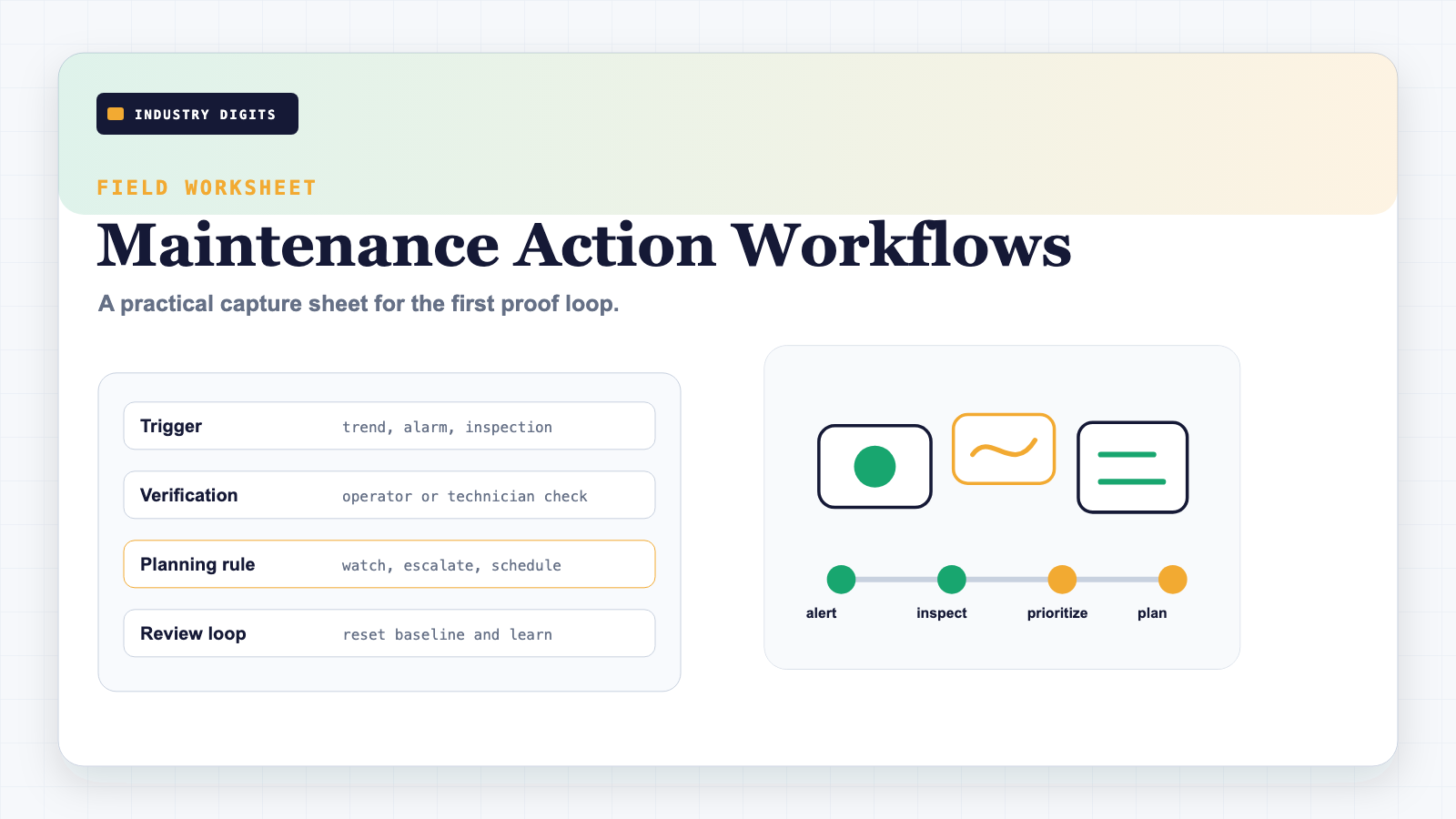
Maintenance decision-window worksheet
Ready visual asset

Maintenance Action Workflows worksheet visual Open worksheet visual
At a glance

How to read this capability

Where this leads

Services and blueprints for this decision

Editorial standard: Diagrams and examples in this hub are implementation frameworks and decision guides, grounded in published standards. Measured client outcomes are published only after verified baselines and approval.

Ready to see what automation could do for your plant?

Discuss Your Project