

Book a Consultation
HomeCapability HubsCritical Asset Signals
Capability hub

Critical Asset Signals

Sensor evidence for bearings, motors, pumps, and other assets where earlier warning can protect uptime and maintenance capacity.

60 seconds
Explainer brief
5
Linked articles
2
Related paths
Decision lens

Which signal gives the maintenance team enough confidence to act before the asset reaches a forced-stop window?

Critical Asset Signals turns sensor evidence into decision windows. The work is not simply mounting sensors; it is choosing the right signal, checking signal quality, setting action bands, and connecting each alert to inspection or maintenance planning.

Wireframe of a monitored rotating asset with mounted sensors and health dashboard
Signal stack to maintenance action
Explainer video brief

From bearing signal to maintenance window

Explain how a trusted condition signal becomes a planning decision without assuming one sensor can solve the full reliability problem.

01
0-12s

Asset context

Visual: Wireframe rotating asset with bearing supports, sensor positions, and operating-state label.

The signal only matters when it belongs to a critical asset and a known operating state.

02
12-28s

Signal trust

Visual: Vibration, temperature, current, and lubrication cards entering a signal quality gate.

Before thresholds, confirm the evidence is stable enough to compare.

03
28-46s

Decision window

Visual: Trend moves from baseline to watch band to action band with inspection and planning markers.

A good signal creates time for planned intervention, not just a louder alarm.

04
46-60s

Action path

Visual: Maintenance work path: inspect, verify, plan, intervene, and reset baseline.

The first implementation should prove the signal-to-action loop on one asset group.

Research in this hub

Articles and field notes that converge on this decision

Each piece below is selected because it sharpens the same operating question — not because it shares a keyword.

Predictive Maintenance

5 Bearing Failure Signals: How To Catch Critical Asset Risk Before The Line Stops

A practical field guide for using vibration, temperature, current, lubrication evidence, and operator observations to turn bearing risk into planned maintenance action.

Read article
Condition-Based Monitoring

Thermal, Vibration, Or Current: Choosing The First Signal That Earns Trust

A condition monitoring decision guide for choosing the first signal that builds trust, protects maintenance capacity, and gives earlier warning on critical assets.

Read article
Condition-Based Monitoring

Journal Bearing Monitoring In Sheet Metal Rolling Lines

A technical review of journal-bearing monitoring in sheet metal reduction lines, connecting roll force, viscosity, lubricant feed condition, oil cleanliness, temperature, vibration, and maintenance action.

Read article
IIoT

Industrial IoT Sensor Selection Checklist: From Field Signals To Reliable Decisions

A gated resource for selecting IIoT sensors, transducers, and switches that can survive the plant environment and support reliable operating decisions.

Read article
Energy & Power

Power Generation Automation And IIoT: Reliability, Telemetry, And Maintenance Decisions

A practical reliability guide for power generation and energy assets where automation, IIoT telemetry, and condition monitoring must protect continuity.

Read article
What this hub maps

Signal stack to maintenance action

  1. Asset criticality
  2. Sensor trust
  3. Trend and threshold
  4. Maintenance decision

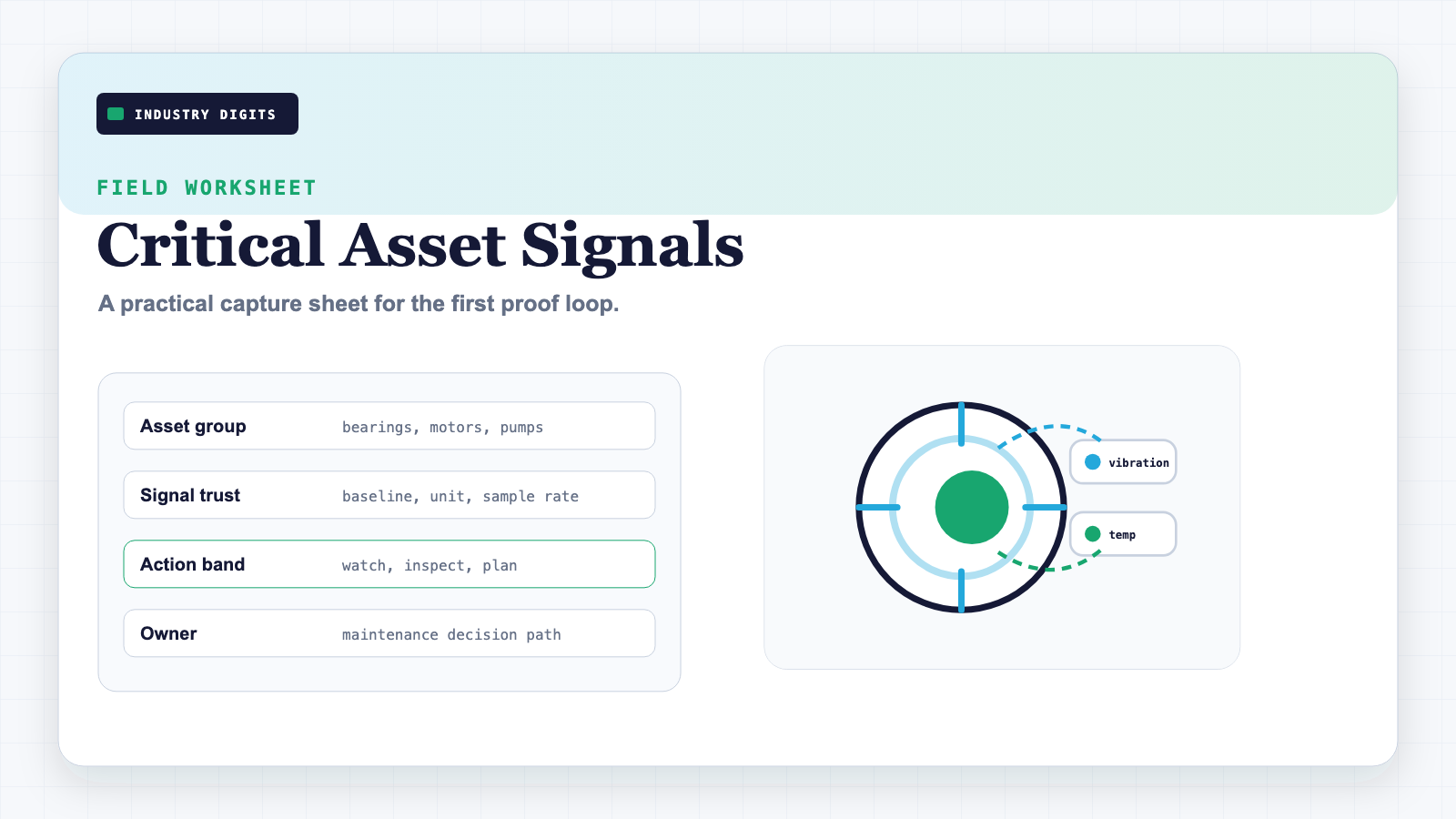
Critical asset signal selection worksheet
Ready visual asset

Critical Asset Signals worksheet visual Open worksheet visual
At a glance

How to read this capability

Editorial standard: Diagrams and examples in this hub are implementation frameworks and decision guides, grounded in published standards. Measured client outcomes are published only after verified baselines and approval.

Ready to see what automation could do for your plant?

Discuss Your Project