
Journal-bearing feed monitoring on a tandem cold mill
How a tandem cold-mill team caught journal-bearing trouble by watching the lubricant feed — read alongside the wider bearing-monitoring literature, and what it changes for rolling-line reliability. Sources cited.
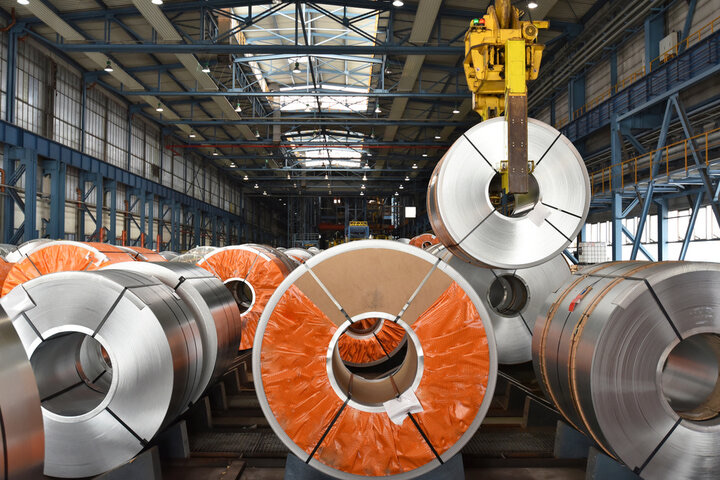
A hydrodynamic journal bearing fails from the oil film outward. By the time vibration clearly changes, the film may already be going. A 2016 study on a tandem cold mill is worth reading precisely because the team refused to wait for vibration — they watched the lubrication itself.
The documented case
Sun and co-authors (2016) describe a monitoring system installed on the back-up roll journal bearing of stand 4 in a 1420 mm tandem cold mill at Baoshan Iron & Steel. Rather than watch the bearing’s vibration, they instrumented its lubrication: hydrodynamic feed pressure, feed temperature, and flow measured close to the bearing inlet.
The target failure was an “online burning” accident — the in-service loss of the oil film that supports a hydrodynamic journal bearing. When that film collapses, metal meets metal and the bearing can be destroyed in minutes, taking the stand with it. The authors report that, over the monitored period, the instrumented stand avoided further unexpected online burning accidents, and they document associated downtime and economic benefits. Read those as a reported result from one installation, not a guaranteed outcome — the value is the method, not a number to copy.
Watching the cause, not the symptom — what the literature supports
The case’s logic — instrument the film, upstream of vibration — is not a one-off. Two reference points put it in context:
- ISO 17359, the umbrella condition-monitoring standard, asks you to choose the measured parameter that changes earliest for the failure mode that matters. For a film-lubricated bearing whose failure mode is burning, that parameter is the lubricant feed — exactly what Sun’s team measured.
- A 2026 state-of-the-art review by Ma and co-authors catalogues a different route to the same failure: acoustic emission, which can pick up the first metal-to-metal micro-contacts as the film thins under different lubrication regimes. Different sensor, same early-warning target.
Read together, the two say something useful: for film-lubricated bearings, the trustworthy signals live upstream of vibration — in the lubricant’s condition (Sun) or in the first micro-contacts as the film breaks down (acoustic emission). Vibration is often the last channel to know. That also reframes temperature: on its own it is ambiguous, but beside feed pressure and flow it becomes far more authoritative — heat says something developed; the feed conditions say whether the film support itself is degrading. (We make the same corroboration point in Bearing Failure Signals.)
The decisions it should change
- Monitor the cause, not only the symptom. For film-lubricated bearings, the lubricant feed — and the onset of contact — sit upstream of vibration. If seizure or burning is a credible failure mode on your line, instrument the oil path.
- Choose the measurement that buys time. The point is to act before the film is lost, so the signal has to move before the bearing does. Pick the earliest trustworthy indicator, even if it is not the obvious one.
- Give the alert an owner and an action. A feed-pressure excursion is only useful if a named person can inspect, slow, or stop the stand before damage. Evidence without a response path is just a louder dashboard.
- Bound the claim. One bearing, one stand, one mill. Reuse the architecture; re-measure the thresholds and the economics for your own asset.
Where it stops generalizing
The authors themselves flag the boundary: the system covered one journal bearing in one stand and needed expansion for broader coverage. The downtime and economic figures are specific to that installation and period. Treat the approach as transferable and the numbers as local — anything else over-reads a single, honest case.
Sources
- Sun, B. et al. “A Method of Feeding Conditions Monitoring of Journal Bearing in Tandem Cold Mill.” Measurement and Control (SAGE), 2016. doi.org/10.1177/0020294016650698
- Ma, J.; Yu, J.; Zhou, X.; Gu, F.; Jiang, L.; Li, X. “Condition monitoring of journal bearings based on acoustic emissions: A state-of-the-art review.” Friction 14(1), 2026. doi.org/10.26599/FRICT.2025.9441080
- ISO 17359 — Condition monitoring and diagnostics of machines · ISO 20816 — Mechanical vibration: evaluation of machine vibration
Related implementation paths
- Critical Asset Monitoring for vibration, temperature, current, and lubrication evidence.
- Bearing & Rotating Asset Monitoring for the signal-to-action pattern.
- Metals & Cement for harsh-environment reliability context.
- Bearing decision-window estimator to turn evidence into an inspect-to-act window.
This is an independent analysis of published work — not an Industry Digits client engagement. The original studies are cited in full above. We use the case to show how a monitoring decision was framed on a real rolling line, and what transfers to other plants.
Discuss a Similar Problem