
From sensor to decision: a sieving-screen bearing failure
How vibration evidence caught an inner-race bearing fault in a calcium-carbonate plant — the sensors, the signal methods that found it under heavy noise, and what it changes for your monitoring. Sources cited.
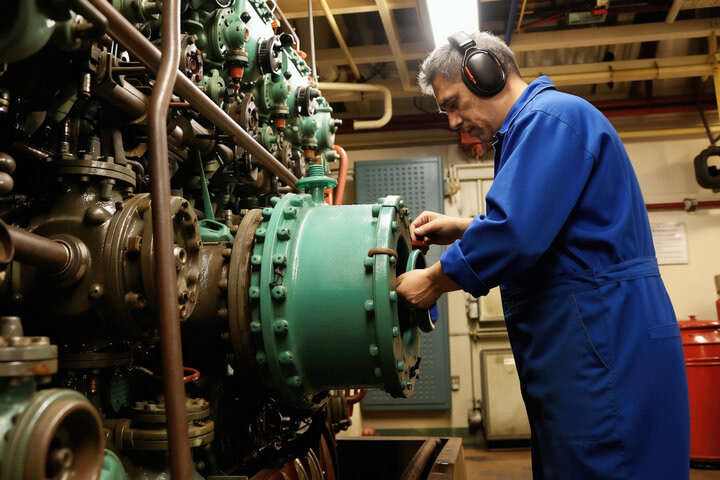
A vibrating sieving screen is one of the harder places in a plant to hear a failing bearing. The machine is designed to shake, and the product it screens rains down as impulsive noise that buries the very signal you are listening for. A 2023 study at an Omya Group calcium-carbonate plant is a clean record of how the fault was caught anyway — and read next to the foundational bearing-diagnostics literature, it shows the find was method, not luck.
What was monitored
Wodecki and co-authors (2023) instrumented a horizontal vibrating sieving screen whose inertial vibrators run on SKF 22324 spherical roller bearings, driven by 30 kW motors at roughly 1,470 rpm. They recorded acceleration with Kistler 8702B500 accelerometers in two directions at a 50 kHz sampling rate (plus a microphone), then ran the signals through RMS, spectrograms, cyclic spectral coherence, and envelope analysis.
The screen is a hostile place to measure. In the authors’ words, “falling pieces of sieved material generate heavy-tailed impulsive non-Gaussian noise” — exactly the interference that defeats a simple overall-vibration reading.
Why those methods — and what the wider literature says
This is where one case becomes a pattern. The methods Wodecki’s team reached for are the ones the field has prescribed for decades:
- Randall and Antoni’s widely cited tutorial (2011) frames the core problem: a bearing defect produces a train of weak impacts easily masked by stronger signals from the rest of the machine. Their answer — the procedure “successful in the majority of cases” — is envelope analysis: band-pass around a structural resonance the impacts excite, then demodulate. That is exactly the route the sieving-screen study took.
- Tandon and Choudhury’s review (1999), one of the most-cited papers in the field, reached the same conclusion a decade earlier, singling out the high-frequency resonance (envelope) technique for localised defects in rolling-element bearings.
Two foundational reviews, twenty-plus years apart, point at the same method — and a 2023 plant case shows it surviving genuinely awful noise. That agreement is the value: the approach transfers even when the machine and the material do not.
The evidence
The analysis flagged inner-race pitting on one bearing — damage spanning roughly 120° of the race, about a third of the surface. After the bearing was replaced, the vibration indicators dropped sharply, which retrospectively confirms how strongly the defect had been driving the signal:
| Indicator (before → after the repair) | Reported change |
|---|---|
| Time-series RMS | −68% |
| Cyclic spectral coherence amplitude ratio | −85% |
| Envelope-spectrum harmonics | −80% |
| Shaft-orbit dimensions | up to −96% |
Vibration on the damaged side fell roughly fivefold after the repair; sound pressure fell only about twofold. The accelerometer felt the fault; the microphone barely heard it. The diagnosis was then confirmed by visual inspection of the removed bearing, which showed clear pitting on the inner race.
Which sensor actually does this
The method only works if the sensor and its mounting can deliver the signal the algorithm needs.
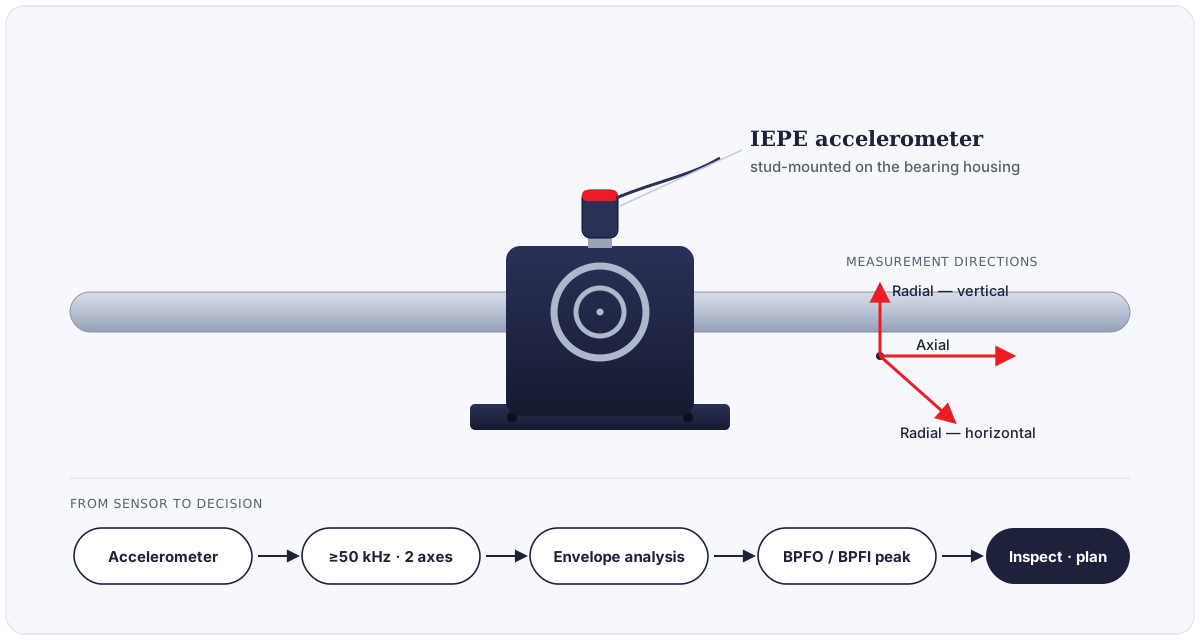
The study used a Kistler 8702B500 — an IEPE (voltage-mode) accelerometer rated to high g, chosen because bearing impacts are sharp and easily clipped. You do not need that exact part; you need its characteristics. The industrial accelerometers most teams actually deploy for this are close cousins:
- PCB Piezotronics 603C01 — the general-purpose 100 mV/g industrial workhorse.
- IMI Sensors 607A11 — a low-cost industrial IEPE sensor for routes and screens.
- Wilcoxon 786A — a rugged 100 mV/g sensor common on heavy machines.
- SKF CMSS 2200 — a standard accelerometer on SKF monitoring hardware.
The selection logic is the same across all of them: enough bandwidth to capture the resonance the envelope demodulates (which is why the case sampled at 50 kHz, not the few-hundred-Hz of a basic trend), enough range that sharp impacts are not clipped, and a stud mount on the bearing housing in the load zone — not glued to a guard, where the signal you want is the first thing lost.
What it should change on your floor
- Match the method to the noise. On screens, crushers, and mills that live in impulsive noise, plan for envelope or cyclostationary analysis from the start — a single RMS trend is the metric people quietly stop trusting.
- Treat acquisition as a design decision. Axis count, sensor placement, and sampling rate decide what is even knowable. Write them down per asset, the way the case did.
- Close the channels you are not instrumenting — on purpose. The plant had no permanent bearing-temperature channel, so heat could only be caught on manual rounds. That can be a fair trade; it should be an owned one.
- Keep a verification loop. The value here came from confirming the prediction against the opened bearing — a step the authors note is rarer in the literature than it should be.
Where it stops generalizing
One screen, one bearing type, one material. The noise environment — falling calcium carbonate — is specific; your impulsive sources differ. The methods transfer; the thresholds do not. And this is a diagnostic demonstration, not an economic one: the study makes no downtime or cost claim, and neither should anyone reusing it.
Sources
- Wodecki, J.; Krot, P.; Wróblewski, A.; Chudy, K.; Zimroz, R. “Condition Monitoring of Horizontal Sieving Screens — A Case Study of Inertial Vibrator Bearing Failure in Calcium Carbonate Production Plant.” Materials 16(4):1533, 2023 (open access, CC BY). doi.org/10.3390/ma16041533
- Randall, R. B.; Antoni, J. “Rolling element bearing diagnostics — A tutorial.” Mechanical Systems and Signal Processing 25(2):485–520, 2011. doi.org/10.1016/j.ymssp.2010.07.017
- Tandon, N.; Choudhury, A. “A review of vibration and acoustic measurement methods for the detection of defects in rolling element bearings.” Tribology International 32(8):469–480, 1999. doi.org/10.1016/S0301-679X(99)00077-8
- ISO 20816 — Mechanical vibration: evaluation of machine vibration · ISO 17359 — Condition monitoring and diagnostics of machines
Related implementation paths
- Industrial Data & IIoT Architecture for trustworthy machine-data flow from sensor to decision.
- Critical Asset Monitoring for the asset-health and signal strategy.
- Sensor placement guide for where to measure on rotating machines.
- Bearing defect frequencies field reference for reading the spectrum down to the defect.
This is an independent analysis of a published, peer-reviewed and open-access case — not an Industry Digits client engagement. The original study is cited in full above. We use it to show how raw vibration becomes a maintenance decision, and what that path demands of your instrumentation.
Discuss a Similar Problem